
By Shyamal Kashyap
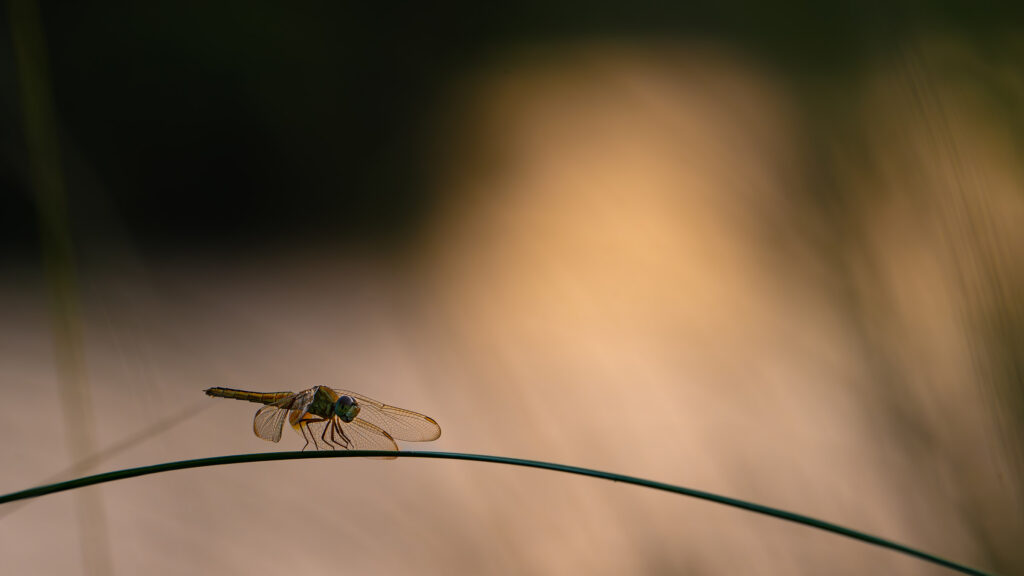
The first sign of a healthy wetland is not always the haunting call of a waterbird or the splash of a fish breaking the surface.
Sometimes, it is far more subtle—a dragonfly hovering effortlessly above a quiet marsh, or a slender damselfly clinging to a blade of grass beside a forest stream.
Their iridescent bodies catch the morning light for only a moment before disappearing into the landscape.
To many, they are fleeting flashes of colour.
To nature, they are something far more important.
They are among the oldest inhabitants of freshwater ecosystems.
Long before scientists collect water samples, measure dissolved oxygen or analyse the chemistry of a river, dragonflies and damselflies can provide clues about the condition of the habitats around them. Their presence, abundance and species composition can reflect aspects of water quality, vegetation, hydrology and habitat structure. The disappearance of sensitive species can sometimes provide an early warning that an ecosystem is beginning to change.
Collectively known as odonates, dragonflies and damselflies are far more than beautiful insects. They are valuable bio-indicators—organisms whose presence, absence and community composition can provide information about environmental conditions.
Because odonates spend part of their lives beneath the water and another part in the air above it, they connect aquatic and terrestrial ecosystems in an unusual way. Changes in water quality, vegetation, flow, temperature and surrounding habitat can affect the species able to survive there.
For conservationists, researchers and naturalists, that makes them remarkably useful.
A diverse odonate assemblage can provide valuable evidence of a functioning freshwater ecosystem. Beneath the water, fish, amphibians and aquatic insects live among submerged vegetation and sediments. Along the banks, reeds, grasses and shrubs provide shelter and breeding sites for wildlife, while surrounding forests can regulate water temperature, reduce erosion and influence the flow of streams.
Dragonflies and damselflies are woven into this ecological network.
Yet despite their importance, odonates rarely receive the same attention as birds, butterflies or mammals. They are photographed for their brilliant colours, admired for their graceful flight and then largely forgotten.
Their ecological role, however, is every bit as fascinating as the more celebrated wildlife that shares their habitat.
A Region of Water and Wings
Stretching from the mighty Brahmaputra Valley to the cloud-covered mountains of Arunachal Pradesh, and from the limestone hills of Meghalaya to the forested landscapes of Nagaland, Manipur, Mizoram and Tripura, Northeast India contains an extraordinary mosaic of freshwater habitats.
Snow-fed rivers descend from the Eastern Himalayas. Rainforest streams wind through ancient forests. Marshes, oxbow lakes, peatlands, ponds and seasonal wetlands appear across the landscape, each creating different conditions for aquatic life.
These landscapes provide an extraordinary range of habitats for dragonflies and damselflies.
Many species are associated with fast-flowing mountain streams shaded by dense forests. Others depend on floodplain wetlands, marshes or quiet ponds. Some are widespread across the plains, while others are restricted to particular valleys, elevations or forest streams.
Together, they represent one of the richest yet comparatively underexplored components of Northeast India’s freshwater biodiversity.
Although remarkable progress has been made by Indian odonatologists over the past two decades, many parts of Northeast India remain insufficiently surveyed. Numerous rivers, forest streams and remote wetlands have never been studied comprehensively, while many districts still lack detailed inventories of their odonate fauna.
Every field expedition can therefore produce valuable information—extending known distributions, documenting breeding populations and revealing species in places where they have not previously been recorded.
In many parts of the region, the next important discovery may lie only a few kilometres beyond the nearest road.
That is what makes Northeast India such an exciting frontier for odonate research.
Every dragonfly observed beside a forgotten marsh, every damselfly photographed along a forest stream and every carefully documented record contributes to a deeper understanding of freshwater ecosystems that sustain not only insects, but birds, amphibians, reptiles, mammals and people alike.
It is a way of understanding the hidden health of rivers, the quiet resilience of wetlands and the intricate web of life that depends upon freshwater.
And in a region where freshwater habitats are under increasing pressure, few stories are more important to tell.
Masters of the Air
If freshwater is the foundation of an odonate’s life, then flight is its greatest triumph.
Long before birds ruled the skies, and before flowering plants became dominant across the continents, the ancestors of modern dragonflies had already evolved sophisticated flight.
Their evolutionary history stretches back more than 300 million years, making odonates one of the oldest surviving groups of winged insects on Earth.
During the Carboniferous Period, vast swamp forests covered parts of the planet, and giant dragonfly-like insects with wingspans approaching 70 centimetres patrolled prehistoric skies.
Those giants disappeared millions of years ago.
But today’s dragonflies and damselflies belong to an ancient lineage whose evolutionary history reaches back to that distant world.
Few creatures alive today carry such a deep evolutionary legacy.
Yet what makes odonates remarkable is not simply their age. It is the extraordinary effectiveness of a body plan that has persisted through immense evolutionary change.
Watch a dragonfly hunting over a wetland and it quickly becomes apparent that every movement is precise.
It hovers above the water before accelerating with astonishing speed, makes an abrupt turn, pauses in mid-air and changes direction almost instantly.
To the human eye, these movements appear effortless.
Behind this graceful flight lies one of nature’s most sophisticated insect flight systems.
Unlike birds, whose wings operate as a pair, dragonflies possess four wings that can be controlled with considerable independence. This gives them remarkable control over lift, direction and stability.
They can hover, move forwards and backwards, manoeuvre sideways and execute rapid aerial turns.
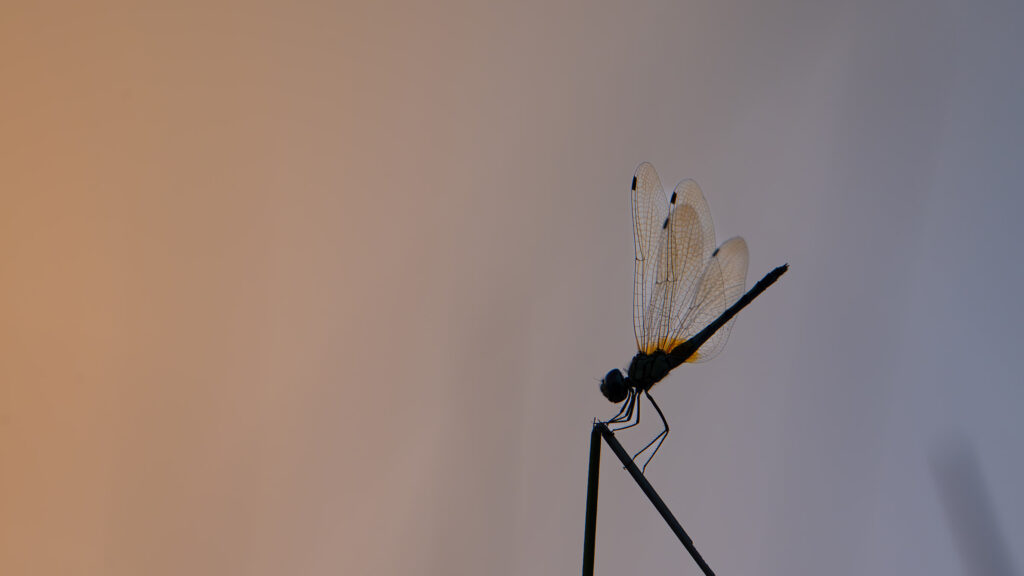
Such manoeuvrability is not merely spectacular.
It is essential to the way dragonflies hunt.
A dragonfly survives by catching prey that can be just as agile as itself. Mosquitoes, flies, midges and other small insects can change direction rapidly, making simple pursuit an inefficient strategy.
Instead, the dragonfly can intercept a moving target by adjusting its own trajectory to meet the prey in flight.
In this sense, it is an aerial interception specialist.
And the precision begins with its eyes.
A dragonfly’s head is dominated by a pair of enormous compound eyes, among the most sophisticated visual systems found in insects. Each eye consists of thousands of tiny visual units called ommatidia, together creating an enormous field of view.
The arrangement allows dragonflies to detect movement across much of their surroundings without constantly turning their heads.
Their visual system can also detect ultraviolet wavelengths beyond the range of human vision. This ability contributes to their capacity to distinguish patterns and movement in their environment and can play a role in locating prey, recognising potential mates and interacting with other dragonflies.
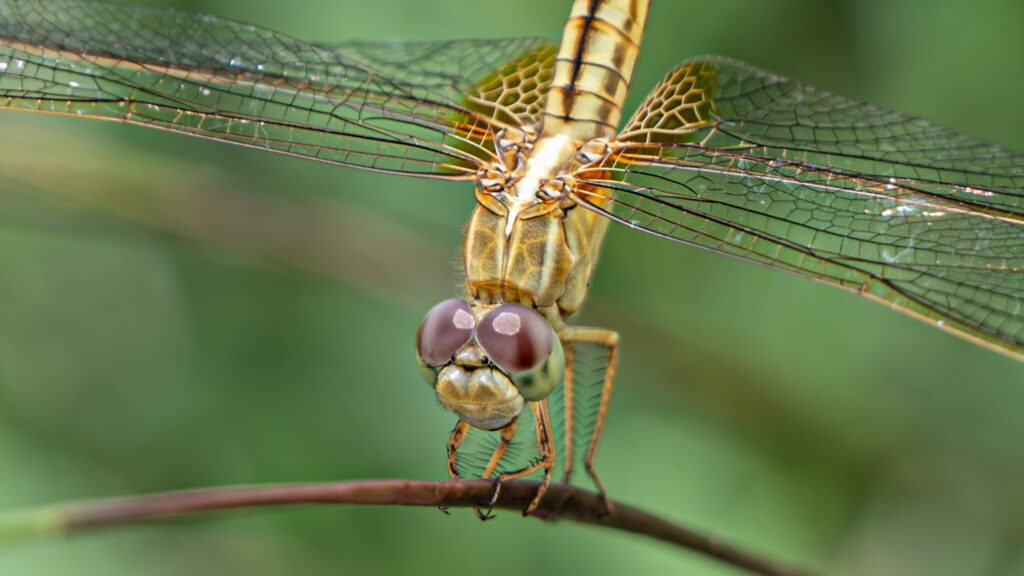
Their nervous systems process visual information at remarkable speed.
Rather than consciously calculating a mathematical trajectory, the dragonfly’s visual and nervous systems allow it to lock onto moving prey and adjust its flight path rapidly enough to intercept it.
The capture itself is equally impressive.
As the dragonfly closes in, its six spiny legs extend forward to form a basket-like trap. The prey is seized from the air, often while the dragonfly remains in flight.
It is a hunting strategy refined through an immense evolutionary history.
Dragonflies are remarkably successful aerial predators, and their hunting contributes to the complex food webs of wetlands, streams and other freshwater habitats.
Across Northeast India, these ancient hunters patrol an astonishing variety of landscapes.
Brilliant skimmers glide above floodplain wetlands of Assam. Delicate damselflies cling to vegetation beside Himalayan streams. Powerful dragonflies patrol forest rivers flowing through the evergreen valleys of Arunachal Pradesh.
Each species occupies its own ecological niche, adapted to particular combinations of water, vegetation, temperature, flow and surrounding habitat.
To watch a dragonfly in flight is therefore to witness more than beauty.
It is to witness the result of more than 300 million years of evolutionary history—an extraordinary flight system that has allowed these insects to persist across changing landscapes and climates.
For an insect lineage that began its journey long before the rise of birds, the skies of Northeast India remain its kingdom.
A Life Between Water and Sky
For all their brilliance in the air, dragonflies and damselflies spend surprisingly little of their lives with wings.
The elegant hunter gliding above a marsh is only the final chapter of a much longer story—one that begins beneath the surface of a river, hidden among submerged roots, aquatic vegetation and layers of sediment.
It is a world of silence, where sunlight fades quickly and danger lurks in every direction.
Here, the dragonfly exists in a completely different form.
Known as a nymph, the young odonate bears little resemblance to the graceful adult that will one day patrol the skies.
It has no iridescent wings, no slender adult body and none of the brilliant colours that attract photographers and nature enthusiasts.
Instead, it is compact, heavily armoured and perfectly adapted for life underwater.
Depending on the species and environmental conditions, this hidden stage may last from a few months to several years. It is often the longest phase of an odonate’s life.
During this period, the nymph grows through a series of moults before it is finally ready to emerge.
It is during this unseen period that one of freshwater’s most formidable predators takes shape.
Unlike caterpillars that feed primarily on plant material, odonate nymphs are predators from the moment they begin feeding. Concealed among aquatic plants, beneath stones or partially buried in soft sediment, they wait for prey to approach.
When the moment comes, the attack is almost instantaneous.
The nymph possesses one of the most extraordinary hunting tools in the insect world—a highly modified lower lip known as the labium.
Folded beneath the head while at rest, it can be projected forward with remarkable speed to seize unsuspecting prey and then retract just as quickly.
Mosquito larvae, mayfly nymphs, freshwater crustaceans, tadpoles and, in larger species, even small fish can fall victim to this underwater predator.
Although rarely seen by people, odonate nymphs are important components of freshwater food webs. They consume a wide range of aquatic organisms and, in turn, become prey for fish, amphibians and other aquatic predators.
Their role is therefore not simply that of predator.
They are also prey.
Eventually, however, even the perfectly adapted underwater nymph must leave the water.
When its final moult approaches, the nymph climbs out onto an emergent reed, grass stem, riverside rock or tree trunk leaning over the water.
Depending on the species, emergence may take place at night, during the early morning or during another relatively cool period.
Anchored firmly above the water, the nymph becomes still.
Then the skin along its back begins to split.
Over the next period of time, a pale and fragile adult gradually pulls itself free from the empty shell. At first, its wings are crumpled and its body appears soft and colourless.
Slowly, fluids move through the network of wing veins, expanding the wings to their adult form.
As the new exoskeleton hardens, colour and structure become more defined.
Deep blues, emerald greens, fiery reds and golden ambers may emerge, replacing the ghostly appearance of the newly emerged insect.
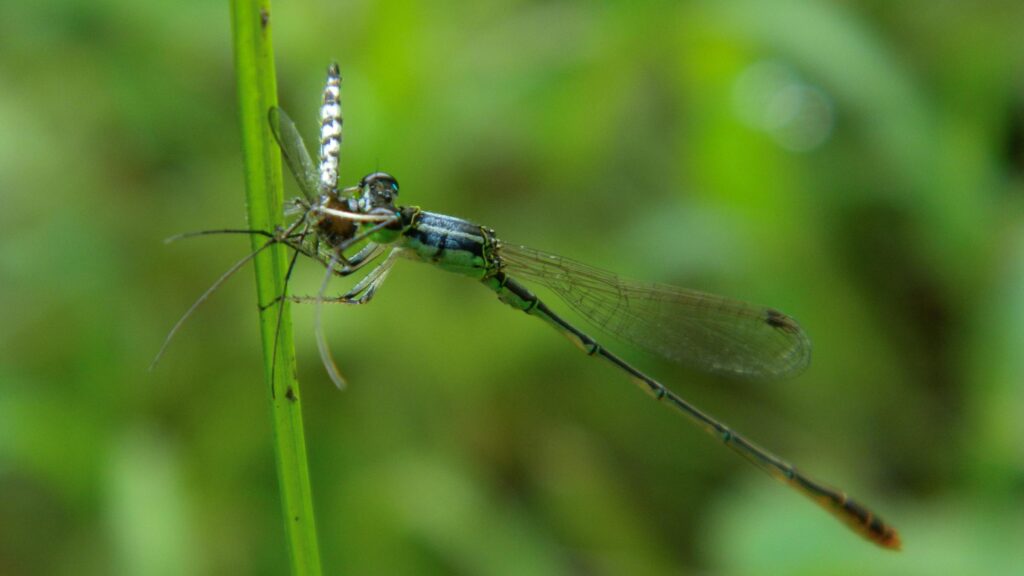
Once its wings have expanded and hardened sufficiently, the dragonfly or damselfly takes its first flight.
Clinging to the vegetation nearby remains the exuvia—the discarded skin of the nymph, a silent record of one of the most extraordinary transformations in the natural world.
This remarkable life cycle makes odonates unusual among insects because they connect two ecosystems that are often viewed separately.
As nymphs, they are integral parts of aquatic food webs. As adults, they emerge into the terrestrial world, where they become swift aerial predators of mosquitoes, flies, gnats and other flying insects.
But they are not only predators.
They are also prey.
Bee-eaters can snatch dragonflies from the air. Kingfishers may capture newly emerged adults near water. Drongos, wagtails, swallows and flycatchers can feed on flying insects, while frogs, spiders, lizards and even larger dragonflies may seize opportunities to feed on them.
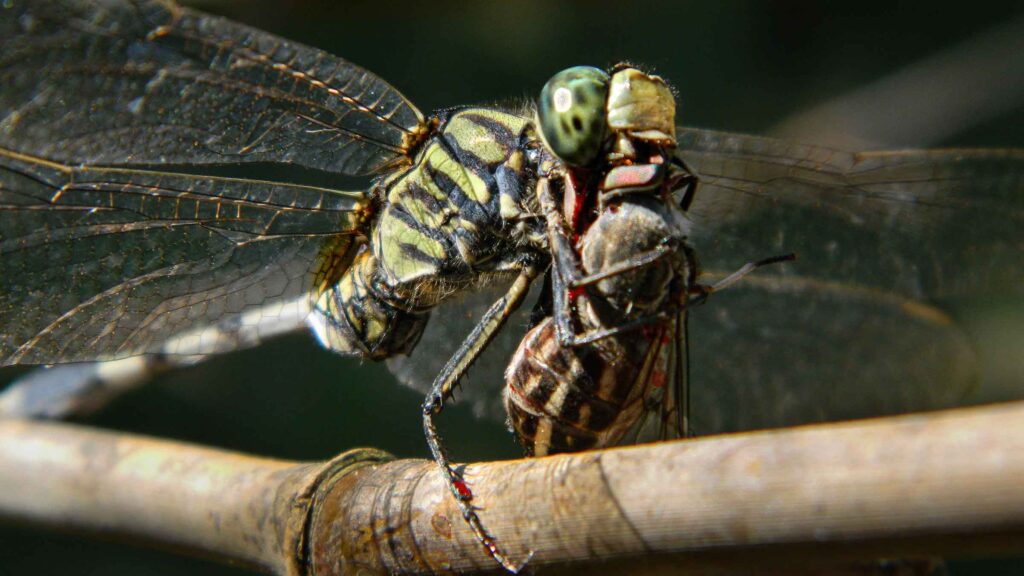
In this way, odonates serve as a biological bridge between water and land.
The biomass produced during their aquatic stage is transferred into terrestrial food webs when adults emerge and become prey for birds, reptiles and other predators.
It is a connection that often goes unnoticed, yet it is part of the ecological complexity of freshwater landscapes.
Across Northeast India—from the braided channels of the Brahmaputra to the clear streams of Arunachal Pradesh—this ancient cycle repeats itself.
Hidden beneath the water, nymphs wait patiently in silence.
Above the surface, adults patrol the air with remarkable elegance and precision.
Together, they remind us that a healthy wetland is never defined by water alone.
Its true vitality lies in the connections between water and sky, and in the extraordinary lives that unite them.
The Future Written in Fragile Wings
The rivers and wetlands of Northeast India form some of South Asia’s most dynamic freshwater landscapes.
Every year, monsoon rains transform floodplains into vast seasonal wetlands. Mountain streams swell with rain-fed and snow-fed waters. Ponds and marshes expand and contract with the seasons.
These changing conditions have helped shape the remarkable diversity of dragonflies and damselflies found across the region.
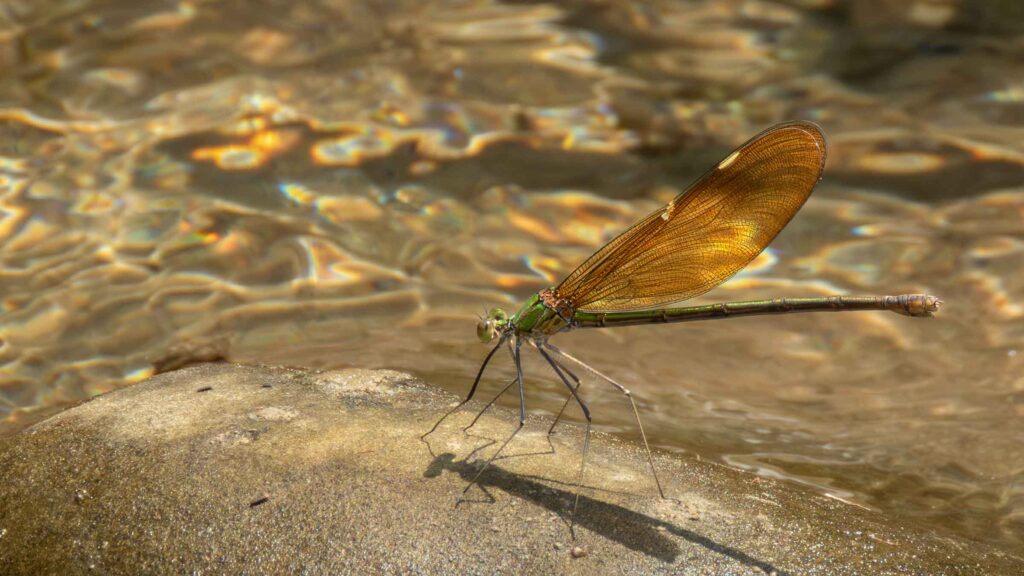
Yet despite its ecological importance, Northeast India remains comparatively underexplored for odonate research.
Remote valleys in Arunachal Pradesh, forest streams in Nagaland and Mizoram, hill rivers in Manipur, peatlands and wetlands in Assam, and countless seasonal water bodies across the Brahmaputra floodplains have received limited attention or have never been surveyed comprehensively.
Many areas still require more detailed species inventories, while the ecology, breeding biology and seasonal movements of numerous species remain poorly understood.
In biodiversity research, unanswered questions are often as important as the answers themselves.
Every unexplored stream holds the possibility of revealing a species not previously recorded from the area.
Every forgotten marsh may support breeding populations that have escaped scientific attention.
Some of Northeast India’s most significant discoveries may still lie hidden in places that few people have visited.
That is both the challenge and the opportunity.
But opportunities are disappearing as rapidly as the habitats themselves.
Freshwater ecosystems are among the most threatened environments on the planet.
Wetlands are drained for agriculture and settlements. Riverbanks are modified by roads and infrastructure. Forests protecting mountain streams are fragmented, while pesticides, industrial pollutants and untreated domestic waste can alter the chemistry and ecological functioning of rivers and ponds.
Climate change adds another layer of uncertainty.
Changing rainfall patterns, prolonged dry periods and increasingly unpredictable floods can reshape freshwater habitats. Species adapted to cool, shaded streams may face additional pressure as water temperatures change, while those dependent on seasonal wetlands may confront increasingly unpredictable conditions.
Dragonflies and damselflies respond to these environmental changes.
The loss of sensitive or habitat-specialist species can sometimes provide an early indication of ecological change, particularly when populations and communities are monitored over time.
A wetland may still appear healthy to the human eye—its surface covered with aquatic plants and visited by birds—while changes in its odonate community may reveal that important ecological conditions are shifting.
Their disappearance is rarely something that should be interpreted in isolation.
Changes in odonate communities can accompany broader changes in aquatic food webs, vegetation, water quality and habitat structure.
Protecting these insects therefore begins with something remarkably simple.
Looking more closely.
Across Northeast India, wildlife photographers, students, researchers and citizen scientists are making valuable contributions to odonate documentation.
A carefully identified and well-documented photograph can help confirm the presence of a species in an area where it has not previously been recorded. Observations of behaviour, habitat, emergence and breeding activity can also contribute to the knowledge needed for future scientific research and conservation planning.
In an age when almost everyone carries a camera, biodiversity documentation has become more accessible than ever.
Responsible wildlife photography is no longer only about creating beautiful images.
It can also become a tool for documenting species distributions, monitoring changes and encouraging greater appreciation of freshwater ecosystems.
Every observation matters.
Every photograph has the potential to become part of a larger scientific story.
For a region as biologically rich as Northeast India, this collective effort may prove essential in filling the many gaps that still exist in our understanding of odonate diversity.
Dragonflies and damselflies have survived for more than 300 million years.
They have witnessed continents drift apart, climates change and countless species come and go.
Through all that time, they have remained closely tied to freshwater habitats.
Their future now depends not on further evolutionary change, but on our willingness to protect the rivers, wetlands, streams and forests upon which they depend.
The flash of a dragonfly above a quiet stream can be more than a moment of beauty.
For some species, it can be a clue that the habitat still retains the conditions they need.
It can remind us that aquatic and terrestrial ecosystems are not separate worlds.
They are connected.
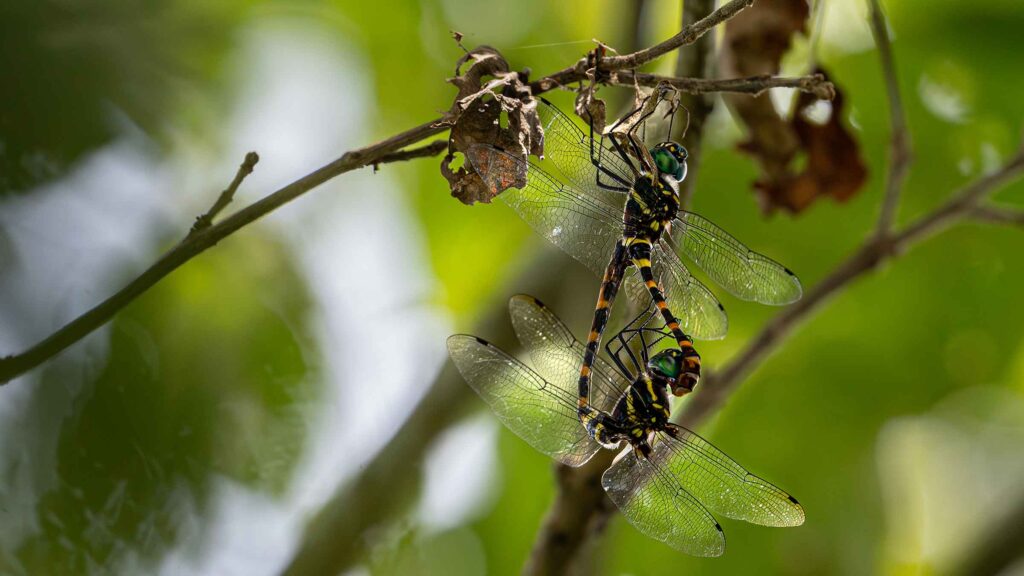
To protect odonates is not merely to conserve another group of insects.
It is to protect the freshwater habitats that support them—and, with them, countless other forms of life.
Perhaps these ancient hunters have been telling us the same story for millions of years.
If we protect the water, they will continue to fly.
And as long as dragonflies and damselflies continue to move above the rivers, marshes, ponds and forest streams of Northeast India, there is still hope for the wild landscapes they call home.