
By Shyamal Kashyap
A River That Never Stands Still
Long before the first rays of sunlight touch the waters of the Brahmaputra, the river belongs to silence.
Mist drifts low across the broad channels, softening the horizon until the boundaries between water and sky dissolve into a single silver landscape. The cool morning air carries the scent of wet sand and river grass, while the only sounds are the gentle murmur of flowing water, the distant whistle of unseen birds and the occasional splash of a fish breaking the surface. As dawn slowly unfolds, vast sandbars begin to emerge from the fading darkness, their pale surfaces glowing beneath the first light of day.
To many people, these islands appear deserted.
There are no towering forests, no dramatic mountains and no permanent villages. Wind sketches delicate ripples across the fine sand, erasing yesterday’s footprints before writing new patterns of its own. Fresh tracks left during the night—those of birds, jackals, turtles and otters—offer the only clues that life has already passed this way. At first glance, these temporary landscapes seem empty, shaped only by the restless current of one of Asia’s mightiest rivers.
But the Brahmaputra has never been a place where first impressions reveal the truth.
What appears to be a barren wilderness is, in reality, one of Northeast India’s richest and least understood ecosystems. Every exposed sandbar, every shallow lagoon and every patch of newly emerging grass forms part of a living corridor that supports an astonishing diversity of wildlife. Here, where land exists for only part of the year before disappearing beneath the monsoon floods, countless species have evolved to thrive in uncertainty.
The Brahmaputra is not merely a river flowing through the landscape.
It is the landscape.
Unlike rivers confined within stable banks, the Brahmaputra continually reshapes its own course. Rising on the Tibetan Plateau before cutting through the eastern Himalayas and spilling onto the plains of Assam, it carries one of the world’s largest sediment loads. Every monsoon, enormous volumes of water transport sand, silt and fertile soil from the mountains into the valley below. Floodwaters sweep across the floodplain with immense power, eroding old banks, carving fresh channels and depositing new layers of sediment across the river’s vast braided network.
When the waters finally retreat, an entirely different world begins to emerge.
Fresh sandbars—known locally as chaporis—rise from beneath the receding river. Some stretch for only a few hundred metres, while others extend for kilometres across the floodplain. Their lifespan is unpredictable. A sandbar that flourishes this winter may disappear beneath next year’s floods, while another may survive long enough for grasses, shrubs and young trees to establish themselves before the river inevitably claims it once again.
Few places on Earth illustrate the power of renewal so vividly.
Here, destruction and creation are inseparable. The flood that washes away an island also lays the foundation for another. Every season, the Brahmaputra redraws its own map, creating a landscape that is never exactly the same from one year to the next.
The Making of a Temporary World
To wildlife, these shifting islands are far more than deposits of sand.
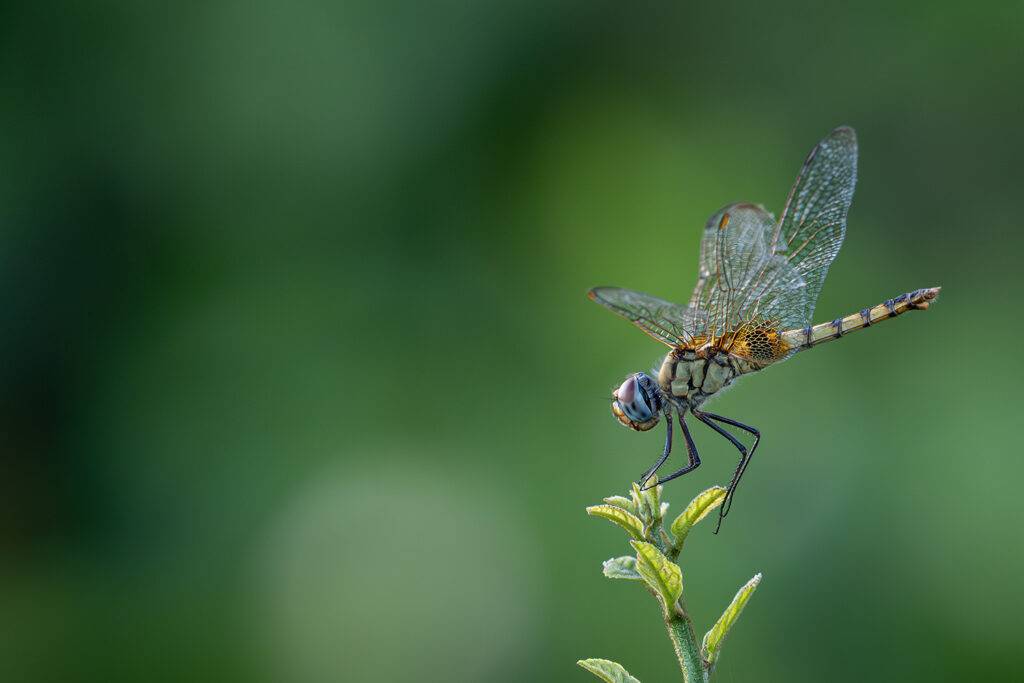
As sunlight warms the newly exposed floodplain, the first signs of life appear almost immediately. Moisture trapped beneath the surface encourages hardy grasses to emerge through the sand. Wildflowers begin to bloom on older islands, attracting butterflies, bees and other pollinating insects. Dragonflies flash like blue sparks above shallow pools, intercepting mosquitoes with astonishing precision before disappearing into the warm afternoon light. Beetles burrow beneath the loose sediment, while spiders stretch delicate webs between newly sprouting grasses.
Within weeks, the seemingly empty sandbar has become an ecosystem.
As the water retreats, fish become concentrated in quiet backwaters and shallow channels, creating seasonal feeding grounds that attract birds from every direction. The river’s annual pulse transforms barren ground into one of the richest dining tables in the floodplain.
Every stage of this transformation depends upon water.
Without the monsoon there would be no fresh sediment. Without the retreating flood there would be no sandbars. Without the sandbars there would be no seasonal grasslands, no nesting colonies, and no vast feeding grounds for migratory birds.
The river writes every chapter of this story.
A Highway Across Continents
Long before winter settles over Assam, the skies above the Brahmaputra begin to fill with travellers.
From the frozen lakes of Siberia, the vast grasslands of Mongolia, the windswept steppes of Central Asia and the high plateaus of Tibet, thousands of birds begin journeys that span continents. Guided by instinct refined over countless generations, they cross snow-covered mountains, deserts and great river systems before finally descending upon the floodplains of the Brahmaputra.
For these travellers, the river is not merely another stop along their migration.
It is a sanctuary.
Its wide channels provide security from many terrestrial predators. The exposed sandbars offer peaceful resting places after exhausting flights, while shallow wetlands and mudflats provide abundant food at a time when survival depends upon quickly rebuilding energy reserves. Together, these habitats form an essential link in the Central Asian Flyway, one of the world’s great migratory routes connecting northern Eurasia with the Indian subcontinent.
Although famous wetlands often receive greater recognition, the Brahmaputra’s ever-changing sandbars are equally vital. Every winter they quietly support thousands of migratory birds, transforming the river into one of South Asia’s most important seasonal wildlife corridors.
The first arrivals often appear as distant silhouettes against the pale eastern sky.
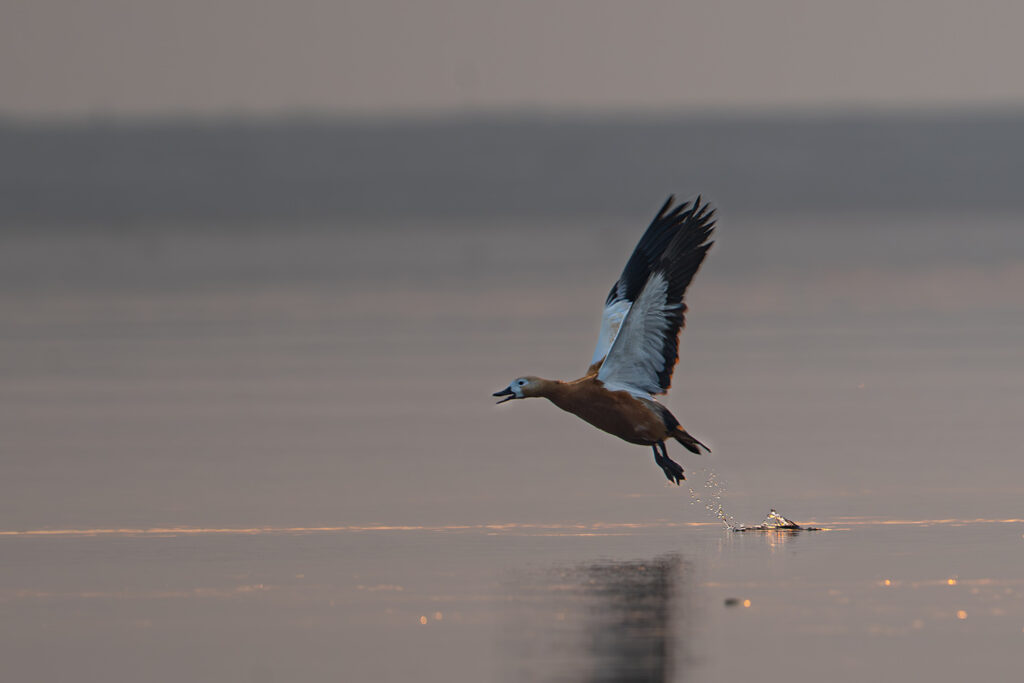
Small flocks of Ruddy Shelduck descend gracefully onto calm stretches of water, their rich cinnamon plumage glowing warmly in the morning sun. Their soft calls drift across the river as pairs paddle through the shallows before climbing onto open sandbanks to rest.
Nearby, Northern Lapwing spread across damp mudflats revealed by falling water levels. Constantly moving, they probe the soft ground for insects, worms and other invertebrates hidden beneath the surface. Every few minutes the flock rises together in a burst of black-and-white wings before settling once more a short distance away.
Along grassy edges of the floodplain, elegant flocks of Bar-headed Goose graze quietly after completing one of the most extraordinary migrations on Earth. Having crossed the towering Himalayas at altitudes where oxygen levels challenge even experienced mountaineers, they spend the winter feeding and resting along the river before returning north with the changing seasons.
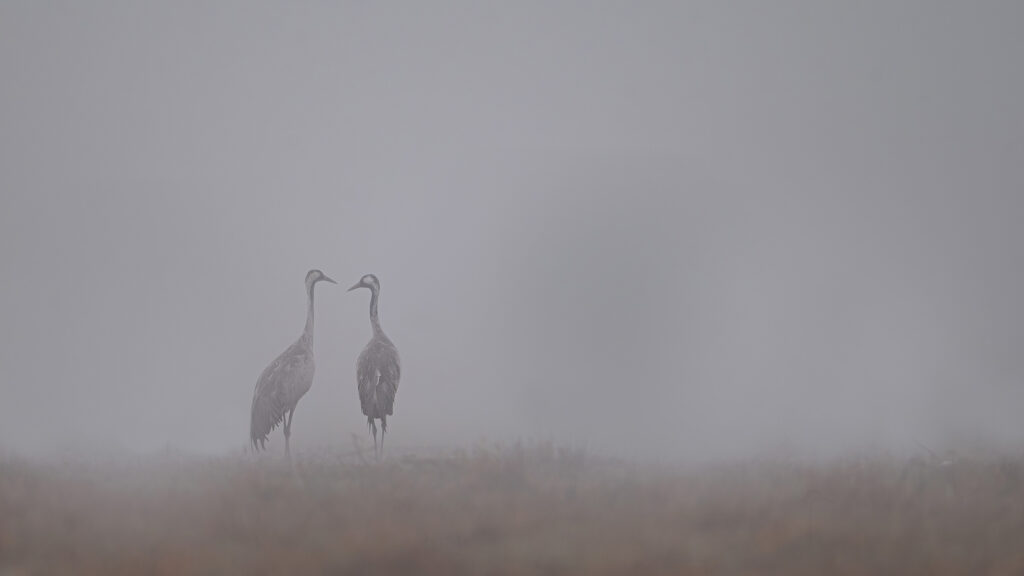
Occasionally, the haunting calls of Common Crane echo across the open floodplain. Their arrival reminds us that this river is connected not only to the mountains that feed it, but also to landscapes thousands of kilometres away. Every migrating bird carries with it the story of another country, another climate and another season.
As the morning sun climbs higher, warm air begins to rise from the sandbars.
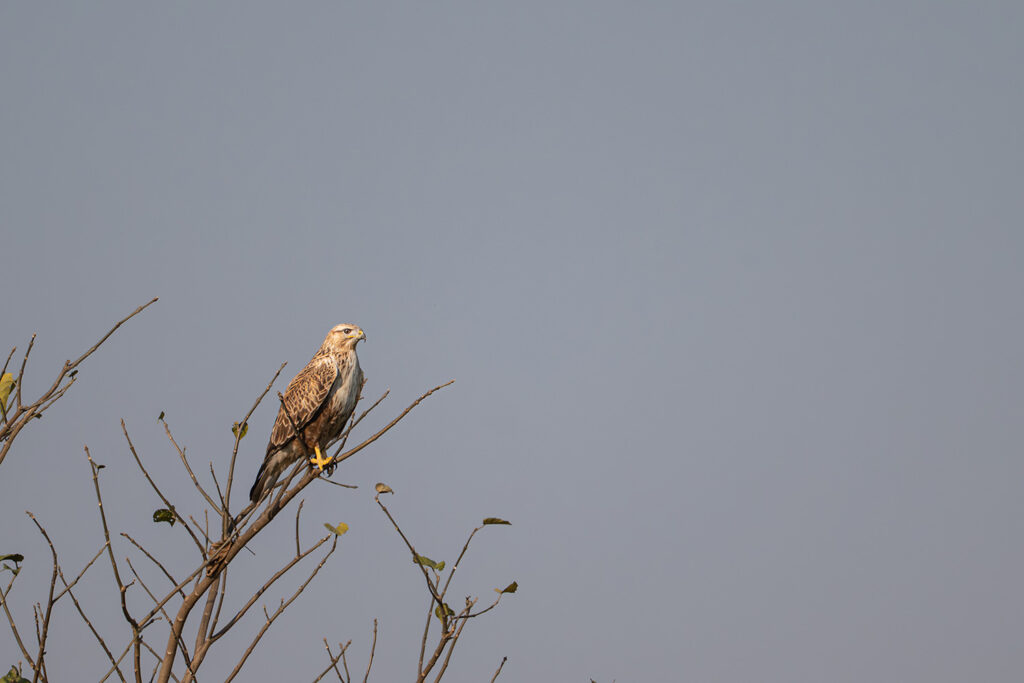
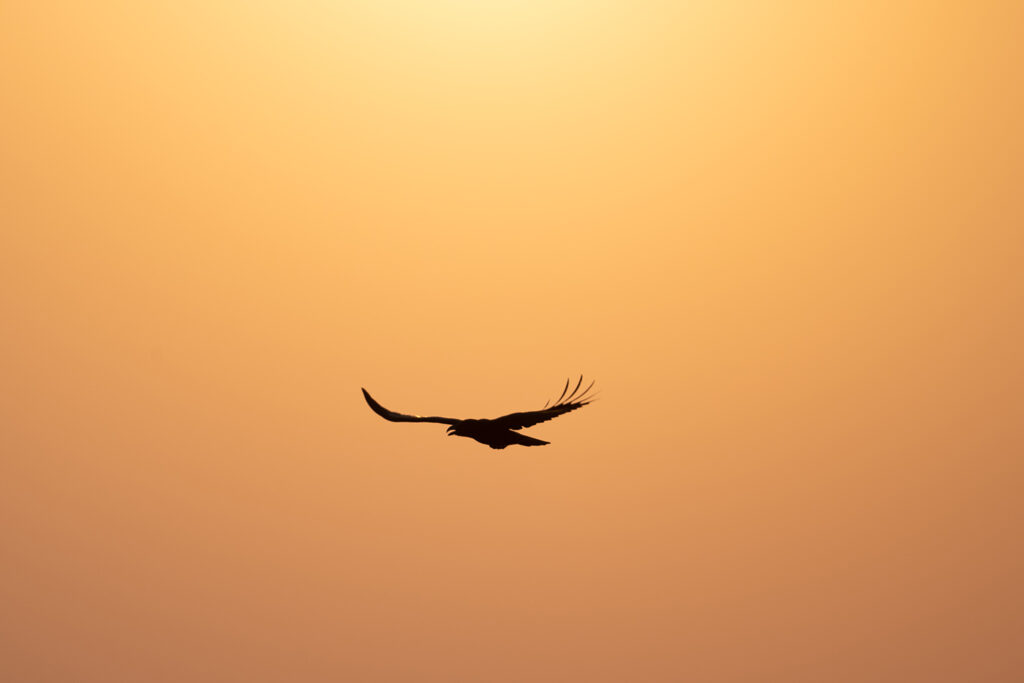
A Long-legged Buzzard climbs effortlessly upon invisible thermals, circling high above the floodplain with scarcely a wingbeat. From its commanding vantage point, every movement below becomes visible—a rodent venturing from its burrow, a basking reptile or an unwary bird feeding in the open.
Soon it is joined by other aerial hunters. Osprey hover briefly before plunging feet-first into the river in pursuit of fish. Western Marsh Harrier quarter low over reed beds with slow, deliberate wingbeats, sending ducks and waders into sudden flight.
Together they reveal another truth about the Brahmaputra.
This is not simply a refuge for migrants.
It is a complete ecosystem where predators and prey, residents and visitors, water and land remain bound together by the river’s endless rhythm.
Masters of the Sandbars
As the sun climbs higher, the mist dissolves and the floodplain awakens completely. What seemed almost lifeless at dawn now reveals a remarkable community of birds that have adapted to one of the most unpredictable landscapes in India. They are not merely visitors to the Brahmaputra—they are specialists, shaped by generations of living in a world that disappears and is rebuilt every year.
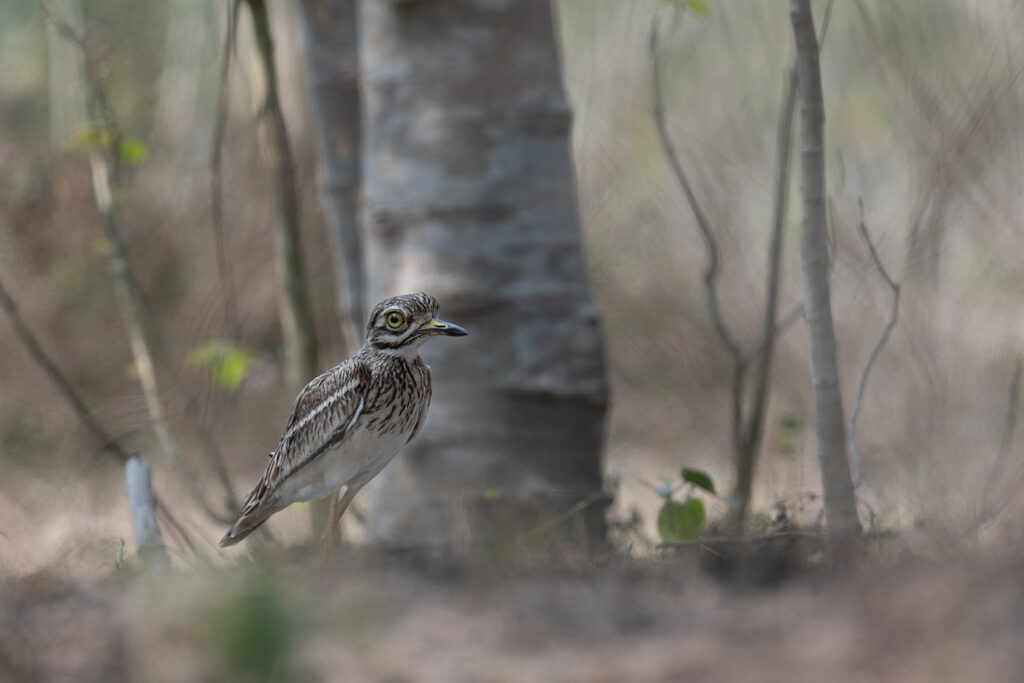
Among the most remarkable is the Indian Thick-knee.
At first glance, it appears to vanish into the landscape. Its sandy-brown plumage mirrors the colours of the surrounding riverbank so perfectly that even experienced birdwatchers can overlook it from only a few metres away. During the hottest hours of the day, the bird stands almost motionless, relying on camouflage instead of flight. Only its striking golden eyes remain alert, constantly scanning the open floodplain for danger.
Its breeding strategy is as extraordinary as its appearance.
Rather than constructing a nest, the Indian Thick-knee simply lays its eggs on bare sand or gravel. Their mottled shells resemble scattered pebbles so closely that predators—and often people—walk past them unnoticed. It is a remarkable adaptation, yet one that depends entirely on the river’s fragile rhythm. A sudden flood, wandering livestock or careless human disturbance can erase an entire breeding season in moments.
Sharing these riverine grasslands is another elusive resident, the Swamp Francolin, one of the most threatened birds of the Brahmaputra floodplain.
Unlike the conspicuous ducks that gather on open water, the francolin prefers secrecy. It slips quietly through dense grasses growing on older sandbars, revealing its presence only through its resonant calls that echo across the river at dawn. Freshly formed grasslands provide ideal cover, but they are temporary. When the monsoon returns, these islands disappear beneath swirling water, forcing the birds to seek new refuges when the river creates them again.
Few places demand such resilience.
Yet year after year, the birds return.
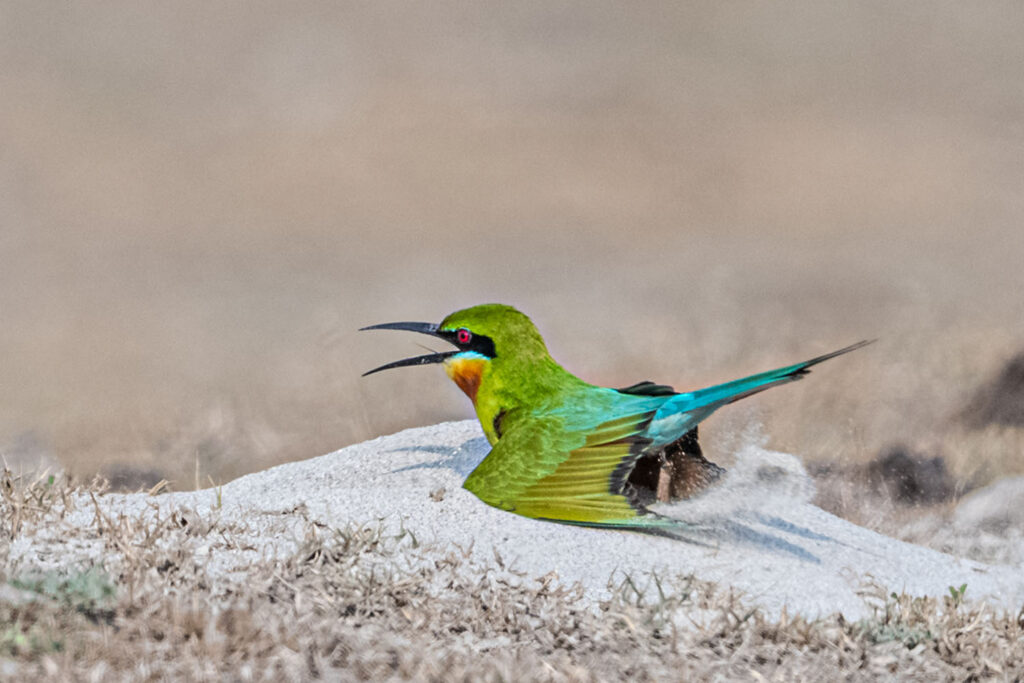
Among the most colourful residents of the floodplain is the Blue-tailed Bee-eater. Often seen darting with agile, acrobatic flight, these birds are masters of the air, expertly catching insects on the wing. They frequently nest in burrows dug into the sandy banks of the Brahmaputra, where they raise their young amidst the changing tides of the river. Their presence adds a vibrant splash of emerald and turquoise to the vast, open landscape, reminding us of the specialized life that thrives in this dynamic environment.
Nearby, elegant River Tern patrol the channels with remarkable precision.
They hover briefly above the current before folding their wings and diving headfirst into the river. Moments later they emerge carrying glittering fish, returning to their colonies on exposed sandbars where hungry chicks wait beneath the watchful eyes of both parents.
The success of these birds depends upon something deceptively simple—undisturbed sand.
The very places that seem empty to people are among the most valuable breeding habitats along the river.
Life Beneath the Surface
While the birds dominate the sky and shoreline, another world exists beneath the muddy waters of the Brahmaputra.
Hidden below the surface swims an astonishing diversity of freshwater fish sustained by nutrients carried from the Himalayas. Every seasonal flood replenishes this underwater ecosystem, supporting a complex food web that extends from microscopic plankton to some of the river’s largest predators.
Suddenly, the calm water breaks.
The smooth grey back of a Ganges River Dolphin rises briefly above the surface before disappearing once again into the opaque current.
Unlike marine dolphins, it lives in a world where vision offers little advantage. The river’s sediment-rich water limits visibility to only a few centimetres. Instead, the dolphin navigates almost entirely through echolocation, producing rapid clicks that bounce off fish and underwater obstacles before returning as echoes. In this hidden acoustic world, sound replaces sight.
Its appearance lasts only seconds.
Then the river becomes still once more.
Along quiet banks, freshwater turtles climb onto sun-warmed logs and exposed sandbars. Some bask for hours beneath the afternoon sun before slipping silently back into the water. Others return under the cover of darkness to lay their eggs deep within the sand, trusting that the river will remain calm long enough for their young to hatch before the floods return.
In the shallows, fish gather in schools where receding water has concentrated food. These rich feeding grounds attract an extraordinary assembly of predators.
Kingfishers perch patiently above narrow channels before plunging into the water like brightly coloured arrows. Herons stalk the margins with slow, deliberate steps, freezing for long moments before striking with astonishing speed. Egrets follow grazing livestock along wetter islands, seizing insects disturbed by every footstep.

Every species occupies its own role.
Every movement contributes to the rhythm of the river.
The Small Architects of the Floodplain
It is easy to admire the cranes, dolphins and soaring raptors.
Yet the true foundation of the Brahmaputra’s biodiversity often lies in creatures measured not in metres, but in millimetres.
Dragonflies flash above shallow pools like fragments of living sapphire, hunting mosquitoes with extraordinary precision. Damselflies cling delicately to reeds swaying beside quiet lagoons. Butterflies drift from flower to flower across older sandbars where seasonal vegetation briefly transforms pale sand into colourful meadows.
Beneath the surface, countless aquatic insects begin their lives underwater before emerging into the air, providing food for swallows, pratincoles and dragonflies alike.
Bees pollinate flowering grasses and shrubs.
Beetles tunnel through damp sediment.
Spiders weave intricate webs between newly sprouted reeds.
Together, these overlooked creatures sustain the larger animals that capture most of our attention.
Without insects, there would be fewer birds.
Without healthy fish populations, dolphins, otters, terns and ospreys could not survive.
The smallest lives often support the greatest spectacles.
A Landscape Written in Footprints
One of the most fascinating stories of the Brahmaputra is rarely seen above the ground.
It is written beneath our feet.
At sunrise, the damp sand becomes a natural record of everything that moved across the floodplain during the night.
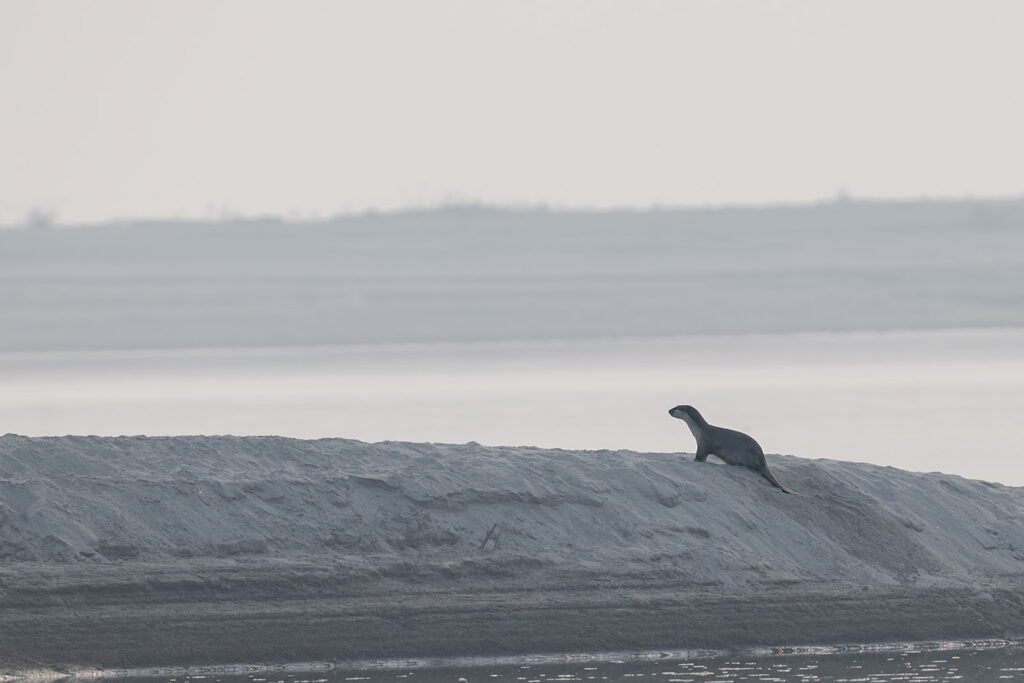
Fresh paw prints reveal the silent passage of Smooth-coated Otter families travelling between channels in search of fish.
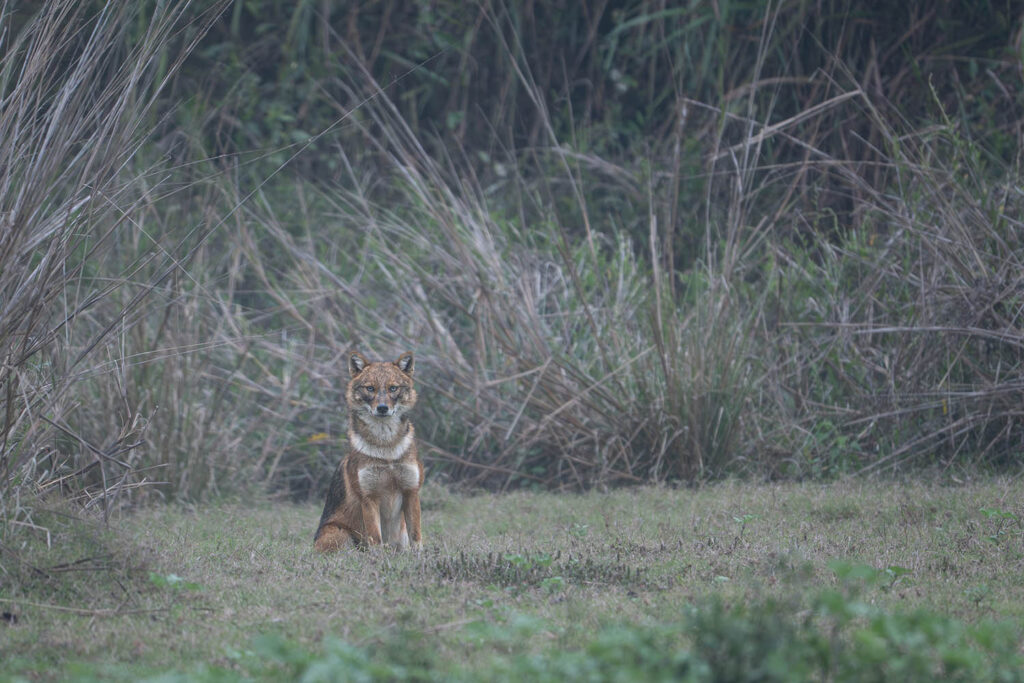
The tracks of Golden Jackal weave along the riverbank before disappearing into tall grass.
Tiny reptile trails form delicate zigzags across warm sand.
The broad footprints of cranes overlap with those of ducks, lapwings and herons, creating an intricate mosaic that records a single night’s activity.
By afternoon, a gentle breeze begins to erase these stories.
By evening, they are gone.
Tomorrow, the river will write new ones.
Nothing here is permanent.
Not the islands.
Not the channels.
Not even the footprints.
And yet, season after season, life returns with astonishing certainty, following rhythms that have endured for thousands of years.
It is this extraordinary balance between permanence and change that makes the Brahmaputra unlike any other river in India.
A Landscape Written by Water
As afternoon fades into evening, the Brahmaputra begins another transformation. The harsh brilliance of midday softens into warm shades of amber and gold. Long shadows stretch across the sandbars, while the river mirrors a sky painted with drifting clouds. Flocks of ducks gather in quiet backwaters, their calls carrying across the floodplain as they prepare for the night. A lone buzzard glides toward a distant perch. Terns make their final fishing dives before darkness settles over the river.
For a brief moment, everything appears peaceful.
Yet this tranquillity is temporary.
Far beyond the horizon, high in the Himalayas where the Brahmaputra begins its remarkable journey, melting snow, glaciers and seasonal rains are already shaping the river’s future. Long before floodwaters arrive in Assam, the river is gathering strength. By early summer, immense volumes of water surge downstream, carrying billions of tonnes of sand, gravel and fertile silt.
The transformation is astonishing.
The quiet channels of winter become powerful torrents. Sandbars disappear beneath swirling brown water. Islands that supported nesting birds only weeks before vanish completely. Grasslands are submerged, and familiar landmarks are erased as the river once again redraws its course.
To many observers, the floods appear destructive.
For the Brahmaputra, they are an act of renewal.
Every flood replenishes the floodplain with nutrients carried from the Himalayas. Fresh layers of sediment create tomorrow’s sandbars, while abandoned channels become wetlands rich in fish and aquatic life. As the waters retreat, sunlight reaches newly exposed ground, triggering another cycle of growth. Pioneer grasses are the first to appear. Insects soon follow. Fish move into fresh pools, and birds quickly discover these new feeding grounds.
The river starts over.
Few ecosystems demonstrate nature’s resilience more dramatically than this annual cycle of loss and rebirth. Life along the Brahmaputra has never depended on permanence. Instead, every species has evolved to anticipate change.
The flood is not the end of the story.
It is the beginning of another chapter.
The Fragile Future of a Living Corridor
Despite its extraordinary ecological importance, much of this seasonal world exists without lasting protection.
Because sandbars appear temporary, they are often dismissed as empty land waiting for cultivation, extraction or development. Yet these shifting islands perform ecological functions that cannot easily be replaced. They provide nesting grounds for river birds, feeding sites for migratory waterfowl, basking areas for turtles, hunting grounds for raptors and mammals, and vital resting places for birds arriving after journeys that span continents.
To wildlife, these places are indispensable.
To people, they often remain invisible.
Across the Brahmaputra, increasing human activity is placing growing pressure on these fragile habitats. Unregulated sand mining removes breeding grounds before birds can complete their nesting cycle. Expanding settlements and agricultural activities alter seasonal floodplains. Plastic waste carried by rivers and left behind by visitors accumulates along quiet shorelines. Boat traffic disturbs waterbirds seeking refuge, while uncontrolled movement across sandbars can unknowingly destroy nests hidden on open ground.
For species such as the Indian Thick-knee and River Tern, even a single disturbance during the breeding season may result in complete nesting failure.
Climate change presents an even greater challenge.
The Brahmaputra is intimately connected to the Himalayas, one of the most climate-sensitive mountain systems on Earth. Changes in glacier melt, snowfall and rainfall patterns have the potential to alter the timing and intensity of floods throughout the basin. Floods arriving earlier than usual may wash away nests before chicks hatch. Longer dry periods could reduce shallow wetlands that sustain thousands of migratory birds.
Because every element of the ecosystem is interconnected, small changes can ripple across the entire floodplain.
Protecting the Brahmaputra therefore requires a broader vision of conservation.
For decades, conservation has largely focused on forests, mountains and protected reserves. These landscapes remain critically important, but rivers demand a different approach. Their health depends not only on the water flowing through them but also on floodplains, wetlands, side channels and seasonal sandbars that appear and disappear with the changing seasons.
The Brahmaputra teaches us that conservation cannot be confined within fixed boundaries.
A living river is itself a protected landscape.
The River’s Greatest Lesson
Perhaps the greatest surprise awaiting anyone who spends time along the Brahmaputra is the realisation that its beauty lies not in dramatic spectacles alone, but in quiet moments that are easily overlooked.
A pair of Ruddy Shelducks resting on an isolated sandbank.
The sudden flash of a kingfisher diving into still water.
A dragonfly suspended above a shallow pool.
The haunting call of a Common Crane drifting across the floodplain at dawn.
The brief arching back of a river dolphin before it disappears beneath the current.
These moments last only seconds.
Together, they tell a story that has unfolded for thousands of years.
The Brahmaputra is often described as one of the world’s great rivers because of its size, its power and its unpredictable floods. Yet its greatest achievement may be something less obvious. It has created one of South Asia’s most dynamic natural corridors—a place where migration, breeding, feeding and renewal occur in an endless cycle guided by water.
Every winter, birds descend from distant continents, trusting that the river will once again provide sanctuary.
Every summer, the floods erase the old landscape and create another.
Every dawn, fresh footprints appear on the sand, recording lives that passed unseen during the night.
The map changes.
The rhythm endures.
In an age when many landscapes are increasingly controlled, fragmented and predictable, the Brahmaputra remains gloriously wild. It reminds us that nature does not always seek permanence. Sometimes its greatest strength lies in its ability to change, adapt and begin again.
Standing on a silent sandbar as the last light fades beyond the horizon, it becomes impossible to think of these islands as empty places. They are crossroads where continents meet through migration, where mountains nourish distant floodplains, and where every season writes a new chapter in an ancient story.
Long after darkness settles over the river, the Brahmaputra continues its timeless work. It shapes islands from sediment carried across the Himalayas. It guides birds over thousands of kilometres with the changing seasons. It sustains creatures seen by millions and others known only to those who pause long enough to watch.
By dawn, the mist will return.
Fresh sandbars will glow beneath the morning sun.
New footprints will appear where yesterday’s have vanished.
And somewhere high above the floodplain, the first flock of migrants will descend once again, following a route older than memory to a river that has never stopped changing.
The Brahmaputra’s greatest secret is not hidden beneath its waters or buried within its shifting sands.
It lives in the extraordinary resilience of the countless creatures that return, season after season, to a landscape that is forever being remade—a living corridor where the story of water and wildlife continues to flow.