
by Shyamal Kashyap
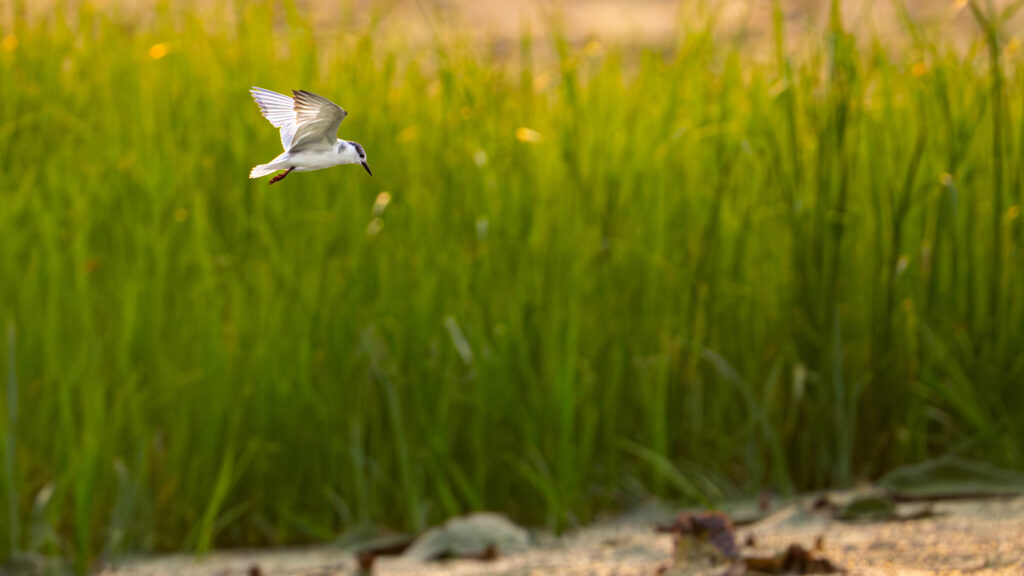
The wetland is alive with movement.
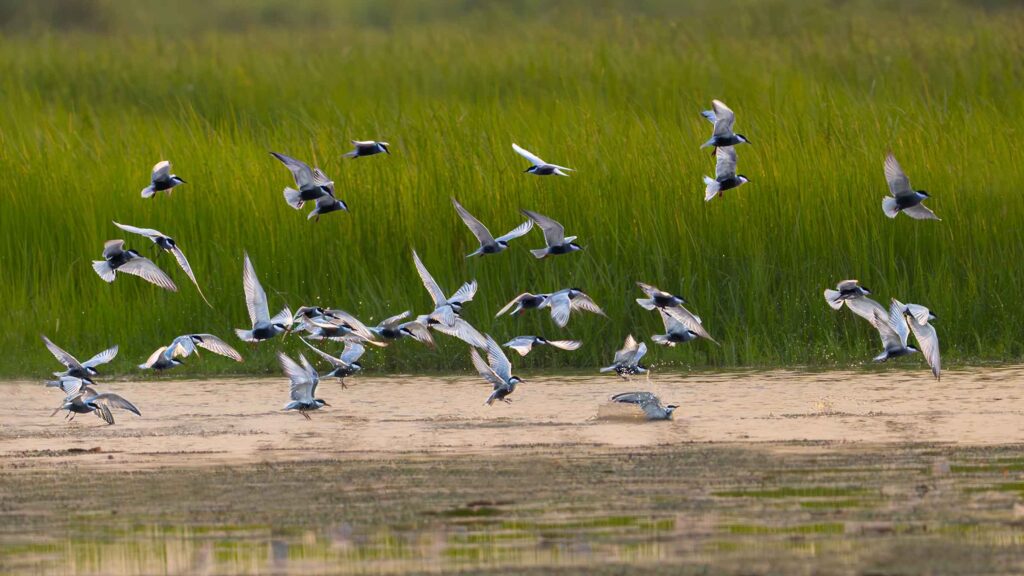
A Whiskered Tern sweeps low over the grass, its long wings carrying it just above the vegetation. Another follows. Farther away, a small group gathers over the shallow water before scattering again across the marsh.
At first glance, it could be just another day on an Assamese wetland.
But then one of the birds turns back carrying food.
It is not returning simply to feed.
It is returning to something.
Somewhere among the vegetation, young birds are waiting.
Over field observations made between 2024 and 2026, Whiskered Terns were documented breeding at three locations in Assam — Deobali Jalah in Nagaon , Joysagar Doloni in Kalibor, and Arimora near Tezpur.
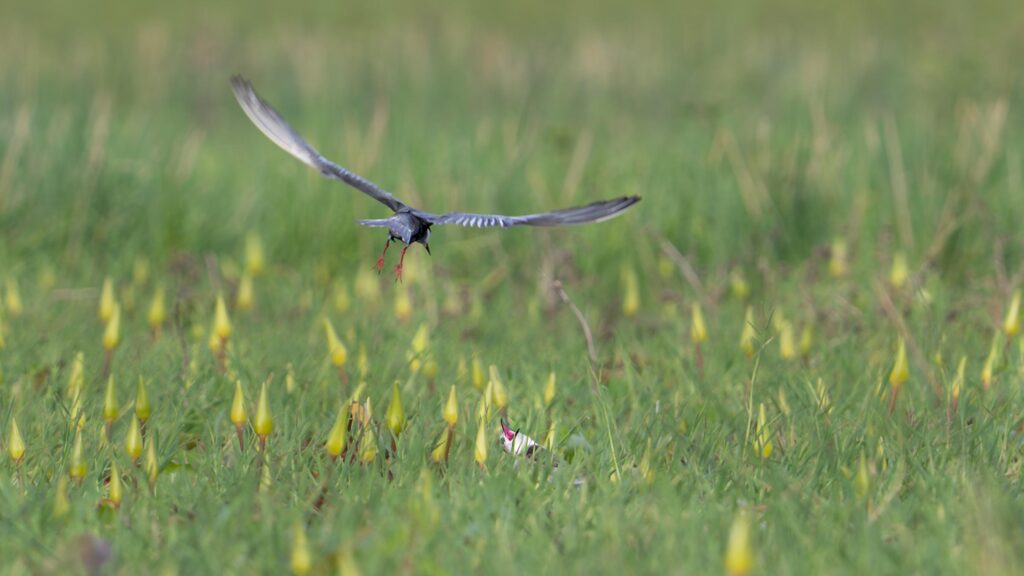
Adults were observed carrying food, while photographs documented chicks alongside adult birds.
These observations add further evidence to the story of Whiskered Tern breeding in Assam — a story that is still being pieced together across the state’s changing wetlands.
A bird of water and open sky
The Whiskered Tern Chlidonias hybrida is a bird closely associated with wetlands.
It moves easily between water and sky, flying low over marshes and shallow water in search of food. During the breeding season, its plumage becomes particularly striking, with a dark head and contrasting pale cheeks set against a grey body.
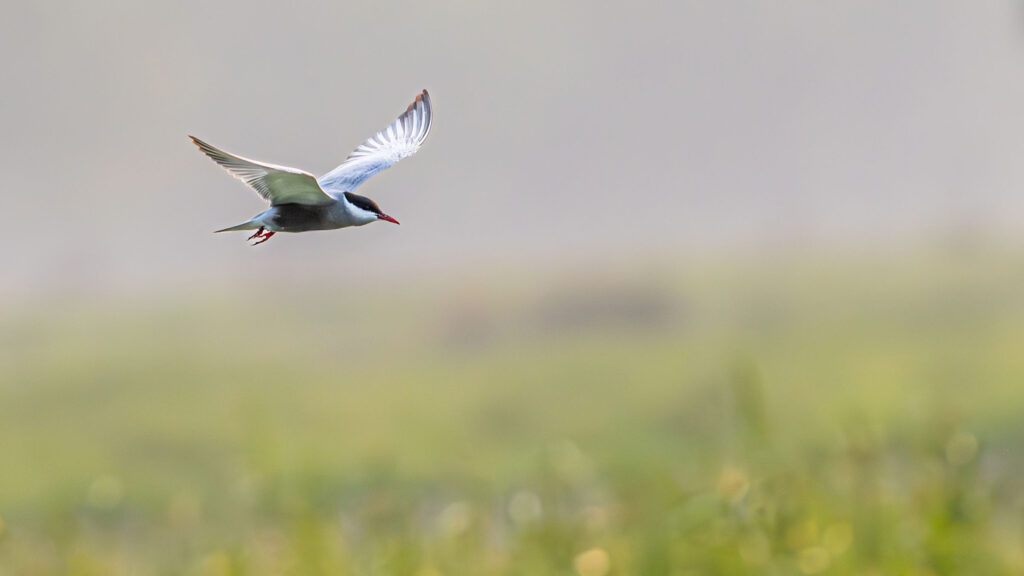
But for a field observer, the most revealing signs are not always found in plumage.
They are found in behaviour.
An adult carrying food towards a particular part of a wetland is a clue.
A bird repeatedly returning to the same area is another.
And when chicks are photographed with adult birds, the story becomes much clearer.
The wetland is not simply being used as a feeding ground.
It is supporting reproduction.
Deobali Jalah: a wetland becomes a nursery
At Deobali Jalah in Nagaon, Assam, Whiskered Terns were observed during the breeding period.
The location was recorded at: 26°14’31.6″N, 92°35’53.3″E
The most significant observations were behavioural.
Adult Whiskered Terns were seen carrying food.
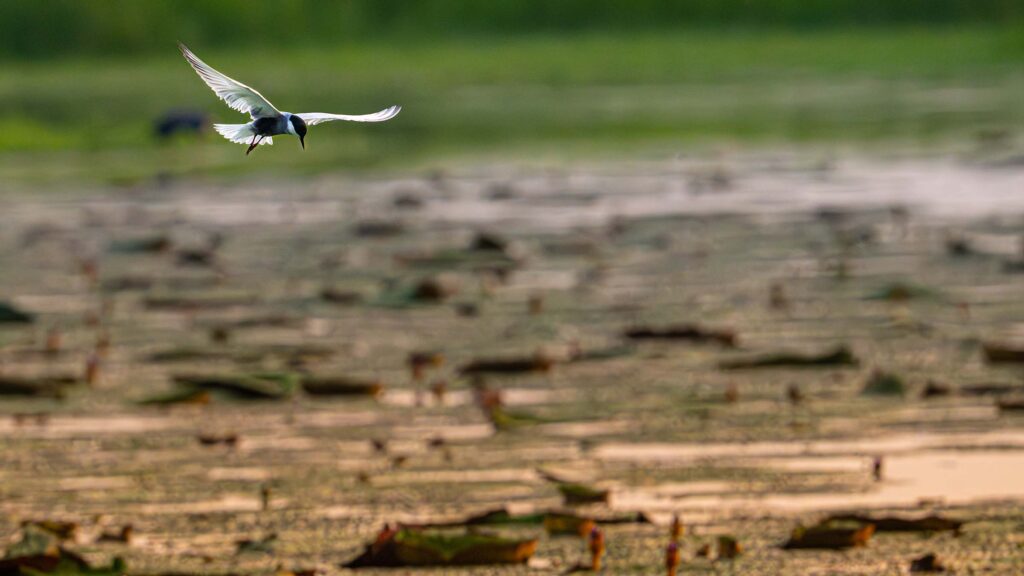
The sight is easy to overlook.
A bird lifts from the wetland, crosses the grass and disappears towards a particular area. In its bill is food for a young bird.
That small movement reveals something much larger.
The adult is investing energy in raising the next generation.
Photographs from the site also documented chicks with adult Whiskered Terns, providing direct visual evidence of breeding.
The photographs capture more than the birds themselves.
They record a moment in the life of the wetland — adults moving across the habitat, young birds remaining close to them, and the surrounding vegetation forming part of the breeding landscape.
For a field naturalist, this is when a wetland changes meaning.
It is no longer simply a place where terns are seen.
It has become a nursery.
Joysagar Doloni: another breeding location
The breeding story continues at Joysagar Doloni in Kalibor.
The location was recorded at: 26°14’32.2″N, 92°35’53.6″E
Here too, Whiskered Terns were observed during the breeding period, with adults carrying food and chicks documented alongside adult birds.
The behaviour provides an important clue to how the birds were using the site.
The adults were not merely passing through.
They were returning with food.
That means the surrounding wetland was functioning as part of a breeding landscape — providing the feeding and nesting environment required to raise young.
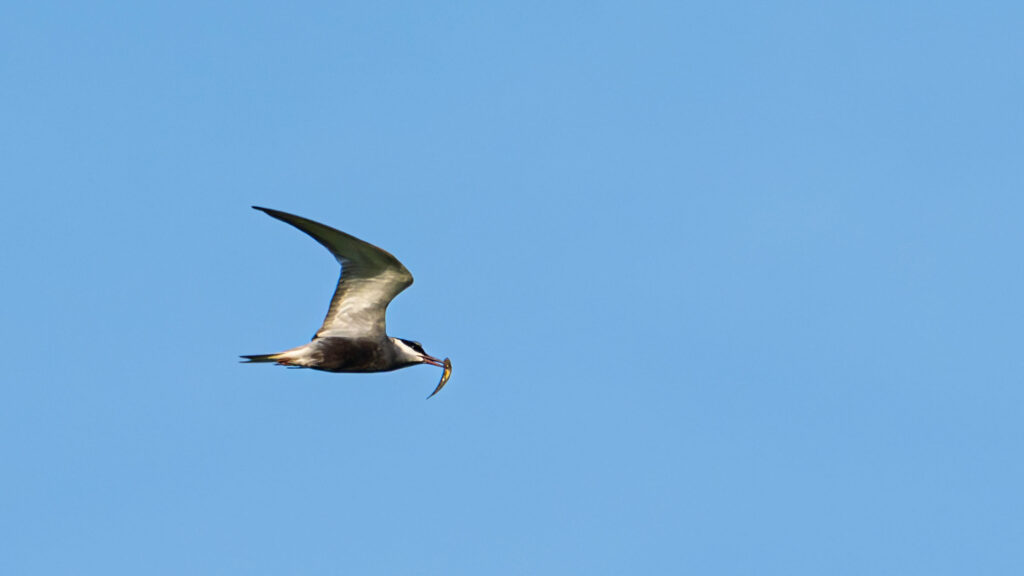
For birds living in dynamic floodplain habitats, the relationship between feeding grounds and nesting areas can be particularly important.
An adult may leave the colony to search for food across open water and vegetation before returning to the young.
From a distance, it is simply a bird in flight.
Watch carefully, however, and a pattern emerges.
The same direction of flight.
The same area of vegetation.
The same repeated journeys.
The wetland begins to reveal its hidden routine.
Arimora: another piece of the puzzle
Further towards Tezpur, another breeding location was recorded at Arimora.
The coordinates are: 26°35’08.1″N, 92°56’28.7″E
Here, too, the evidence came from both observation and photography.
Adult Whiskered Terns were seen carrying food, while photographs documented chicks with adult birds.
The significance of this observation extends beyond the individual birds.
It adds another location to the known picture of Whiskered Tern breeding in Assam.
From the wetlands around Nagaon and Kalibor to the landscape near Tezpur, the observations show that suitable breeding habitat occurs in different parts of Assam.
Each location adds another piece to the map.
And every breeding record raises another question about how these birds use the state’s wetlands.
The photographs tell the story
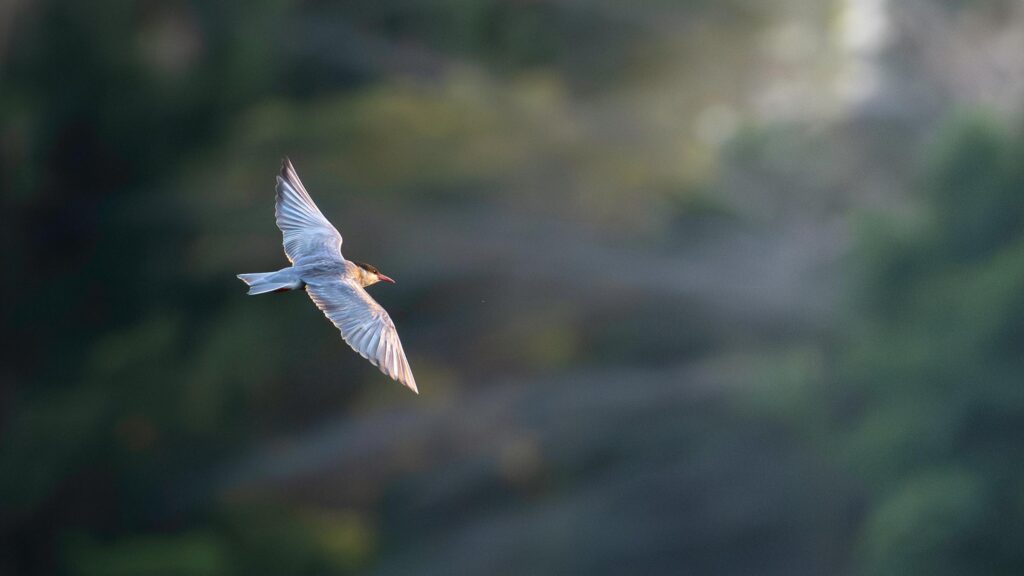
The Whiskered Tern photographs from these observations show the species in its natural setting.
Some photographs isolate an individual bird against the open sky.
Others place the tern within the wetland itself — flying low above grasses, crossing shallow water or moving with other birds.
That difference matters.
A close photograph can establish identification.
A wider photograph can show habitat.
A sequence of photographs can show behaviour.
And a photograph of a chick alongside an adult can become evidence of reproduction. Together, these images help turn a field encounter into a documented natural-history record.
A breeding strategy written in vegetation
Whiskered Terns are colonial breeders and are closely associated with aquatic habitats.
Earlier research in Assam has documented breeding colonies using floating and aquatic vegetation,
including Water Hyacinth Eichhornia crassipes.
Such vegetation can provide a platform for nesting while the surrounding water provides access to feeding
areas.
It is an ingenious use of an unstable landscape.
The birds do not necessarily need a permanent island.
A floating mass of vegetation can become a temporary nursery.
The arrangement, however, is vulnerable to the same forces that create the wetland.
Water levels rise.
Floodwaters move.
Vegetation breaks apart.
Nesting areas can disappear.
The floodplain is never still.
For a breeding bird, that means opportunity and danger are often found in the same landscape.
Three years of observation
The observations made across 2024, 2025 and 2026 are valuable because they place the breeding
records within a wider period of field observation.
The important evidence is not simply that adult birds were present.
It is what they were doing.
Adults carrying food.
Chicks present with adults.
Birds repeatedly using particular wetland areas.
These observations provide evidence that the sites were being used for reproduction.
They also highlight the value of continued field observation.
A single visit can reveal a bird.
Repeated visits can reveal a breeding colony.
Repeated observations across years can begin to reveal the ecological importance of an entire wetland landscape.
The quiet importance of a breeding record
The Whiskered Tern is not one of Assam’s most celebrated birds.
It does not have the imposing size of a stork or the cultural prominence of some of the state’s
better-known wildlife.
Yet its breeding behaviour tells us something important.
A wetland capable of supporting chicks must provide more than water.
It must provide food.
It must provide suitable nesting conditions.
It must provide vegetation or other structures that allow the birds to establish breeding sites.
And, at least temporarily, it must provide enough security for adults to raise their young.
A breeding colony is therefore also evidence of habitat function.
The bird is telling us something about the place.
Assam’s changing wetlands
Assam’s wetlands are shaped by water.
During the monsoon, the landscape can change dramatically. Pools expand, grasslands flood and aquatic vegetation moves across the water.
For wetland birds, these changes can determine where food is available and where breeding is possible.
This makes many breeding sites inherently dynamic.
A colony recorded in one year may not occupy exactly the same patch in another.
The birds respond to water levels, vegetation and food availability.
That is why field records are so important.
Precise coordinates establish where an observation occurred.
Photographs preserve what was seen.
Field notes record behaviour.
And observations collected over several years can reveal patterns that would otherwise remain invisible.
From observation to conservation
The value of these Whiskered Tern records goes beyond adding another species to a checklist.
They draw attention to the wetlands themselves.
Deobali Jalah.
Joysagar Doloni.
Arimora.
Each is a place where the relationship between birds and wetland habitat can be observed directly.
A tern carrying food is a small event.
A chick waiting for its parent is an even smaller one.
But together, these moments tell us that these landscapes are performing an important ecological function.
They are supporting reproduction.
And breeding habitat deserves attention precisely because it is being used at such a critical stage
of the birds’ lives.
Watching what happens next
The most interesting part of these records may be what comes after them.
Do the Whiskered Terns return?
Do they use the same locations in subsequent breeding seasons?
Do the colonies expand or contract?
Does flooding alter their nesting areas?
How many chicks survive?
And are there other breeding colonies across Assam that have simply not yet been documented?
These questions cannot be answered from photographs alone.
They require time in the field.
They require repeated observation.
And they require observers willing to watch a wetland long enough for its patterns to emerge.
The terns that stayed
The Whiskered Terns arrived quietly.
There was no dramatic announcement.
Only wings moving above the wetland.
A bird crossing the grass.
Another returning with food.
Then the first glimpse of a chick beside an adult.
At Deobali Jalah, the birds were recorded at 26°14’31.6″N 92°35’53.3″E.
At Joysagar Doloni in Kalibor, another breeding location was recorded at 26°14’32.2″N, 92°35’53.6″E.
And at Arimora near Tezpur, the coordinates mark another place where the species was observed
breeding: 26°35’08.1″N 92°56’28.7″E.
Three locations. Years of observation. Adults carrying food. Chicks beside their parents. And wetlands doing what wetlands have done for generations — providing a place for life to begin.
For a passing visitor, a Whiskered Tern may be just another bird crossing the sky. But stay and watch. The bird may turn back.
And when it does, it may be carrying food for a chick hidden somewhere below.
That is the moment a sighting becomes a story.
And a wetland becomes a nursery.