
By Shyamal Kashyap
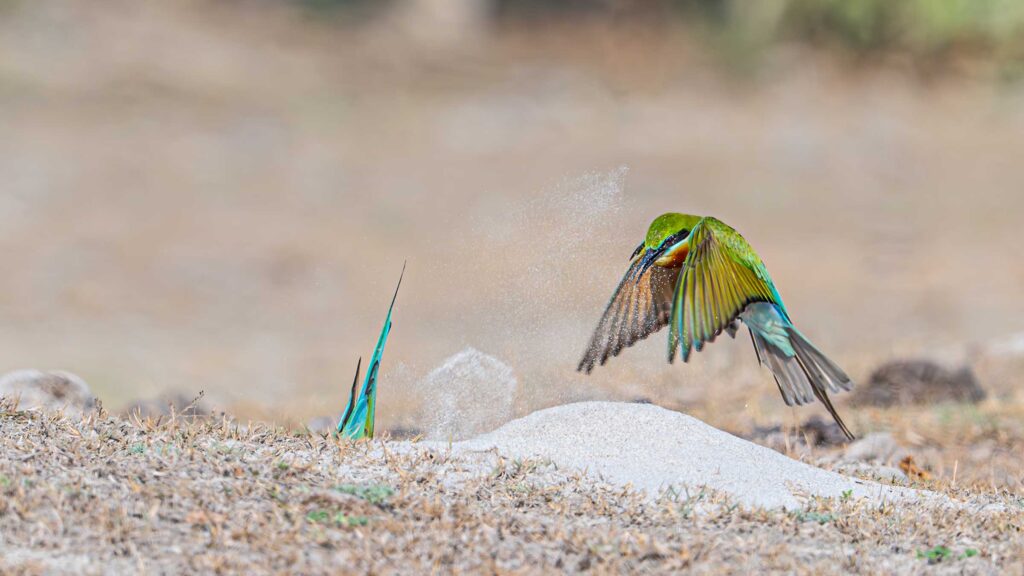
Coordinates: 26° 37′ 52.73″ N, 92° 44′ 1.67″ E
Observation period: February–April, annually from 2021 to 2026
Estimated colony: Around 500 pairs or more, based on field observation
There is a moment when a river island seems to disappear into the landscape.
From a distance, there may be little to distinguish it from the thousands of shifting sandbanks and islands that form and change along the rivers of Assam. There is sand. There is grass. There is open sky.
No forest canopy rises above it. No dramatic cliff marks its edge.
It can look almost empty.
Then the birds arrive.
The silence is broken by wings.
Blue-tailed Bee-eaters sweep across the open ground, turning sharply through the air before dropping back towards the island. Some birds disappear towards the surrounding landscape, while others return almost immediately. Pairs move together. Birds land briefly on the ground before taking flight again.
And beneath them, hidden in the sandy earth, another story is beginning.
The birds are digging.
They are preparing nesting burrows.
Courtship is taking place.
Mating follows.
What appeared to be an ordinary river island has become a breeding ground.
For six consecutive years, from 2021 through 2026, I have observed Blue-tailed Bee-eaters at this island during February, March and April. Across those seasons, the same landscape has repeatedly drawn the birds back.
The observations suggest that this is not simply a temporary stop in their annual movements.
For a period each year, the island becomes a place of reproduction.
A place where hundreds of pairs may gather.
A place where the next generation begins its life.
The Island
The island lies within a landscape shaped by water.
Its surface is dominated by open ground, with sandy areas mixed with grass. In places, the open plain is broad enough to resemble a football field.
There are no obvious signs of importance.
That is perhaps what makes the place so interesting.
Wildlife habitat does not always announce itself.
A forest is easy to recognize as a forest.
A wetland filled with birds immediately attracts attention.
But a sandy river island can look like wasteland.
To the Blue-tailed Bee-eaters, it is anything but.
The open ground provides space for nesting.
The surrounding landscape provides access to flying insects.
And the open sky provides the hunting space these aerial predators need.
The island is therefore only one part of the story.
The birds use the ground and the air together.
They come down to nest and rise into the sky to feed.
Every day, the colony connects the island with the wider landscape around it.
When the Birds Return
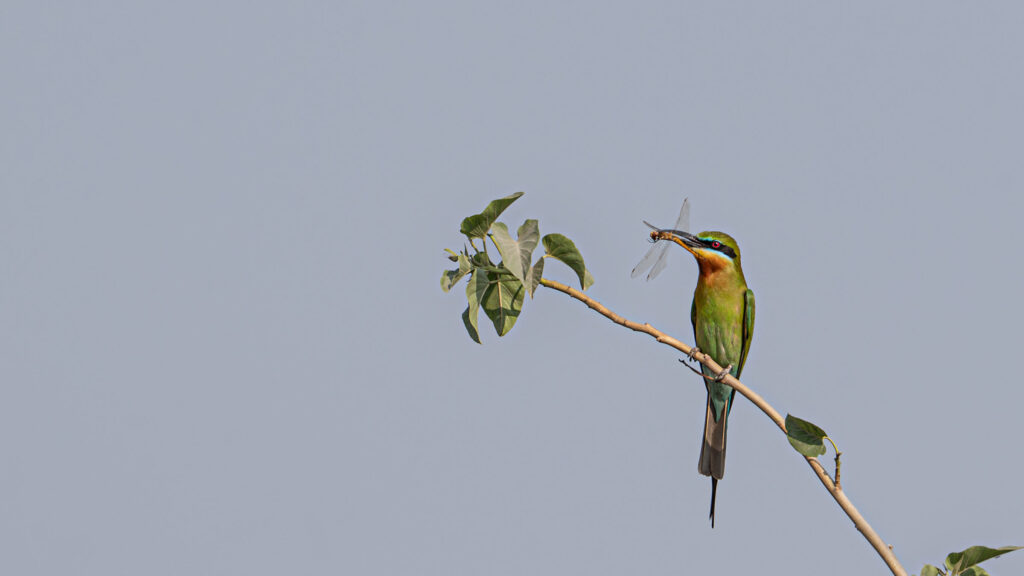
My observations began in 2021.
Since then, I have returned to the area during February to April each year, and the Blue-tailed Bee-eaters have repeatedly been present.
Six years of observations create a different kind of understanding.
A single sighting tells us that a species was there.
Repeated observations begin to tell us that a place matters.
Here, the pattern is particularly striking because the birds are not merely being seen in passing.
They are engaged in breeding behaviour.
They dig into the sandy ground.
They establish nesting areas.
They court.
They mate.
The colony becomes active.
The question of where these birds spend the rest of the year remains an interesting one.
It is tempting to describe them simply as winter visitors because they appear seasonally.
But migration is rarely that simple.
Bird populations can move between regions at different times of the year, and the movements of one population may not perfectly match those of another.
Large-scale distribution data for the Blue-tailed Bee-eater show seasonal movements across its range, including a pre-breeding migratory period during February–May. Such broad-scale models are useful for understanding the species, but they do not by themselves establish the exact movements of the birds using this particular island.
The field evidence here is more immediate.
Whatever their movements before reaching the island, the birds are present here during February to April and use the site for breeding activity.
That is what the island reveals.
The First Sign Is Often in the Sky
A breeding colony of Blue-tailed Bee-eaters is difficult to ignore once it becomes active.
The birds are constantly moving.
One rises from the ground.
Another comes down.
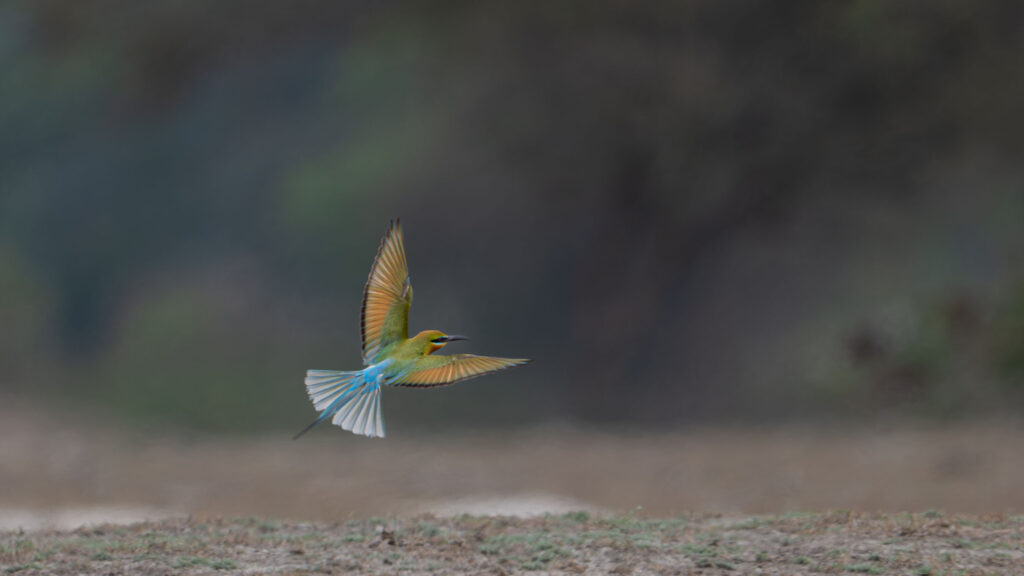
Several sweep across the open sky.
A bird suddenly changes direction and disappears beyond the edge of the island.
Then, moments later, it returns.
Their movements can appear chaotic.
They are not.
The colony is connected to a daily rhythm.
Birds leave to forage.
They return to the nesting area.
Pairs interact.
Some birds remain near the burrows.
Others spend much of their time in the surrounding airspace.
From the ground, the scene can feel almost three-dimensional.
The island lies below.
The birds occupy the sky.
And between the two is an invisible network of movement.
A bird may leave the nesting ground in search of food, travel beyond the island and then return to exactly the same landscape.
The colony is therefore not an isolated patch of habitat.
It is the centre of a much larger ecological system.
Beneath the Sand
The most important activity, however, happens at ground level.
The birds dig.
Watching a Blue-tailed Bee-eater excavate a nesting burrow changes the appearance of the island.
A patch of bare sand no longer looks empty.
It becomes a potential nest.
The bird works at the ground, excavating into the soft substrate. The work may look small compared with the scale of the island, but it is the beginning of a much larger investment.
The nesting tunnel will become a place where eggs are laid and young are raised.
For the observer, it is easy to concentrate on the spectacular parts of the colony—the flight, the colours, the rapid movements.
But the digging is perhaps more revealing.
It shows why the birds have chosen this particular landscape.
The sand is not merely part of the scenery.
It is a resource.
The open ground is not merely empty space.
It is breeding habitat.
This is one of the central lessons of the island.
What looks unimportant from a human perspective can be essential to another species.
Courtship in the Air
The breeding season also brings moments that are difficult to anticipate.
Blue-tailed Bee-eaters are birds of flight, and courtship can unfold rapidly.
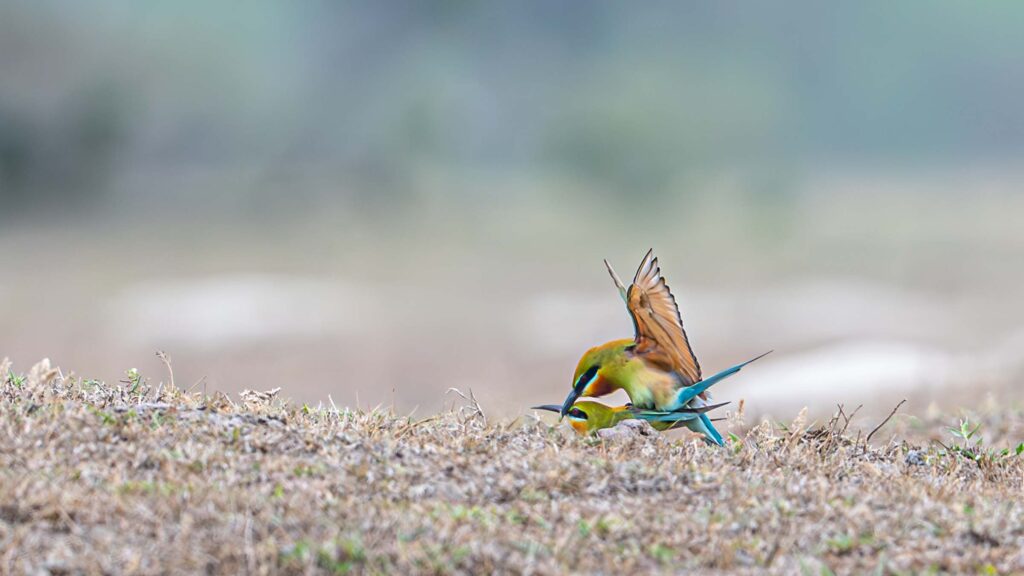
I have photographed the birds mating, including moments when the pair comes together while airborne.
The encounter can last only briefly.
A pair may appear suddenly against the sky, move together for a moment and then separate.
For a photographer, there is little time to react.
The camera has to be ready.
The birds determine the timing.
There is no stage and no second take.
But these images are important because they document something deeper than an attractive moment.
They provide evidence of reproduction at the site.
A photograph of a bird perched on a branch tells us that the species was present.
A photograph of mating tells us something very different.
It places the birds within the breeding cycle.
Combined with observations of digging and repeated seasonal use of the island, these moments help build the picture of a functioning breeding ground.
Hundreds in the Air
The scale of the colony is difficult to ignore.
Based on my field observations, I estimate that there may be around 500 pairs or more using the island and its surrounding breeding area.
This is an estimate, not the result of a formal population census.
Counting a large colony of fast-moving birds is difficult.
Birds are constantly entering and leaving the area. Some may be away feeding. Others may be underground. The visible number at any one moment is therefore unlikely to represent the entire colony.
Even so, the impression of scale is unmistakable.
The island supports a substantial gathering of Blue-tailed Bee-eaters during the breeding period.
Hundreds of pairs potentially using the same landscape create a remarkable spectacle.
The sky becomes crowded with movement.
The sandy ground becomes dotted with nesting activity.
And the relationship between the birds and the island becomes impossible to overlook.
It is no longer simply a place where a few bee-eaters happen to be seen.
It is a colony.
A Landscape Built for Openness
The island’s greatest value may lie in its simplicity.
There is space.
The ground is open.
The sand is exposed.
Grass grows across parts of the plain without completely covering it.
For a burrow-nesting bee-eater, this combination can be valuable.
The birds can access the ground to excavate their nests while maintaining an open landscape around the colony.
The openness also gives them room to move.
There are no dense layers of vegetation obstructing their flight close to the ground.
The surrounding airspace becomes part of the feeding landscape.
The island therefore brings several requirements together in one place.
Suitable ground.
Open space.
Access to food.
And a landscape in which birds can move between nesting and feeding areas.
This is why conservation cannot always focus only on spectacular habitats.
A sandy island may have no towering trees and no dramatic vegetation.
Yet its ecological value can be extraordinary.
The River Is Always Changing
There is another dimension to this story.
The island exists within a river landscape.
That means it is never completely fixed.
Sand moves.
Water levels rise and fall.
Vegetation expands and retreats.
Edges are eroded.
New areas may be deposited elsewhere.
For the birds, this changing environment can create both opportunity and uncertainty.
Freshly exposed sandy ground may provide new nesting habitat.
But the same river processes can also remove existing habitat.
A breeding colony that returns to the same general landscape may not find exactly the same ground every year.
The island itself is part of a natural cycle of change.
That makes its repeated use by the bee-eaters even more interesting.
The birds are responding not to a permanent structure but to a changing landscape that continues to provide suitable conditions.
Their return suggests that, at least during the years of observation, the broader habitat has remained capable of supporting breeding.
A Colony Exposed
Breeding colonies are vulnerable places.
The birds are investing energy in reproduction.
The nests are concentrated.
The young are dependent.
And disturbance can occur at exactly the wrong time.
Human activity is one of the pressures I have observed around the site.
For someone unfamiliar with the colony, the sandy plain can look like an ordinary open space.
There may be no visible sign saying that birds are nesting beneath the ground.
A person can walk across the area without realizing what is there.
That is part of the problem.
The nests are largely hidden.
A burrow entrance can be small and easy to overlook.
The absence of an obvious nest does not mean the ground is empty.
During the breeding season, the safest assumption is that the active colony needs space.
People do not necessarily need to abandon the landscape completely.
But sensitive nesting areas should be approached carefully, and unnecessary movement through the colony should be avoided.
For a bird raising young underground, a seemingly harmless disturbance can have consequences that are invisible to the person causing it.
Predators
The bee-eaters also face another, more natural challenge.
Predators are part of the island’s ecology.
An open breeding colony offers opportunities for predators searching for eggs, young birds or adults.
The birds cannot remove that risk.
It is part of life in the wild.
The same open landscape that gives them room to nest can also make the colony visible.
The same concentration of birds that makes the colony successful can also make it attractive to predators.
For the bee-eaters, breeding is therefore a balance between opportunity and risk.
They have found a landscape suitable enough to return to year after year.
But suitable does not mean safe.
Every breeding attempt carries uncertainty.
Some nests will succeed.
Others will not.
Some young birds will leave the colony.
Others will be lost.
That is the reality of reproduction in the wild.
Watching Without Disturbing
There is also a responsibility for those of us who document wildlife.
A breeding colony can be fascinating to photograph.
The flight shots are challenging.
The mating photographs are rare.
The digging behaviour is revealing.
And a large colony provides an extraordinary visual story.
But the value of the photograph should never outweigh the welfare of the birds.
A photographer does not need to stand inside a colony to document it.
In fact, the best observations often come from distance.
With a long lens, it is possible to watch behaviour without entering the immediate nesting area.
The birds should be allowed to continue their activities naturally.
That principle becomes even more important when a colony contains hundreds of pairs.
A single observer may cause only a small amount of disturbance.
Repeated disturbance by many visitors can be something else entirely.
A breeding ground needs protection not because every human presence is destructive, but because the cumulative pressure can become significant.
Six Years of Watching
Perhaps the strongest part of this story is its continuity.
From 2021 through 2026, I have continued to observe the birds during February to April.
That has allowed me to see the island not as a single moment but as a recurring seasonal landscape.
Each year brings another opportunity to observe.
The birds return.
The ground becomes active.
The colony develops.
Courtship and mating take place.
The birds move between the nesting area and the surrounding landscape.
Then the season passes.
The island becomes quieter again.
This kind of long-term observation is valuable because wildlife stories are often built from fragments.
One photograph.
One sighting.
One unusual behaviour.
But when observations are repeated over several years, a pattern begins to emerge.
The island is being used repeatedly.
The breeding activity is recurring.
And the site deserves to be understood as more than an incidental birding location.
It is a breeding landscape.
What We Still Do Not Know
The observations also raise questions.
How many birds actually use the island?
Does the number remain stable from year to year?
Do the same birds return?
Where do they go after the breeding season?
How far do they travel to feed?
How successful are the nesting attempts?
How many young leave the colony each year?
How does the size and position of the breeding area change as the river reshapes the island?
And how much does human disturbance affect breeding success?
These are questions that cannot be answered through casual observation alone.
They require systematic monitoring.
A proper study could establish the size of the colony more accurately, map nesting areas, record the timing of breeding behaviour and document changes in habitat.
Over several years, such information could become an important baseline for the site.
For now, the photographs and repeated field observations provide the beginning of that record.
More Than a Seasonal Gathering
It would be easy to describe the island simply as a place where Blue-tailed Bee-eaters appear during part of the year.
But that would miss the most important part of the story.
They do not merely appear.
They reproduce.
They dig.
They court.
They mate.
They establish nesting sites.
They raise the next generation.
That distinction matters.
A feeding ground can be important.
A resting site can be important.
But a breeding ground carries another level of ecological significance.
It is where the continuation of the population is tied directly to the condition of a particular place.
If the habitat changes, breeding opportunities can change with it.
If disturbance increases, nesting conditions can deteriorate.
If the open sandy ground disappears, the colony may eventually have nowhere suitable to dig.
The future of the birds is therefore linked, in part, to the future of the island.
The Island’s Quiet Importance
There is a tendency to associate conservation with dramatic landscapes.
Rainforests.
High mountains.
Wetlands filled with thousands of waterbirds.
Protected forests stretching towards the horizon.
But wildlife does not divide the world according to what humans consider beautiful.
For the Blue-tailed Bee-eaters, a patch of sand can be as important as a forest is to another species.
The island does not need to be spectacular.
It needs to work.
For six years, it appears to have done exactly that.
During February, March and April, the open ground becomes a place of intense activity.
The birds return.
The colony forms.
The nesting tunnels are prepared.
Pairs come together.
And the breeding cycle begins.
A Record Written in Sand
There is something fitting about a breeding story taking place on an island made of sand.
Sand is temporary.
The river moves it.
Rain changes it.
Water reshapes it.
Tracks disappear.
Burrows collapse.
The surface is rewritten.
Yet each breeding season, the bee-eaters return and write their own temporary record into the ground.
A tunnel here.
A nesting site there.
Birds moving above.
Pairs forming.
Young eventually taking to the air.
Then the season ends.
The birds leave.
The island becomes quiet again.
Until another February arrives.
And once again, the sky begins to move.
A Place Worth Remembering
For me, the significance of this island lies not only in the number of birds.
It lies in the consistency of the story.
Year after year, from 2021 to 2026, the Blue-tailed Bee-eaters have returned during the February–April period.
The same broad landscape has continued to provide the conditions they need.
I have watched them digging into the sandy ground.
I have watched them in flight.
I have photographed courtship and mating.
I have watched the colony spread across the open plain.
And I have seen the pressures that exist around it.
These observations do not yet answer every question.
They do, however, establish something important.
This island is not empty.
It is not simply sand in the middle of a river.
It is a breeding ground.
Perhaps hundreds of pairs use it.
Perhaps the colony is larger or smaller than the present estimate.
Perhaps future monitoring will reveal movements that are not yet understood.
Those questions remain open.
But the birds have already made one thing clear.
This place matters.
When the Sky Fills With Wings
Stand on the island during the breeding season and it is possible to forget how ordinary the landscape looked from a distance.
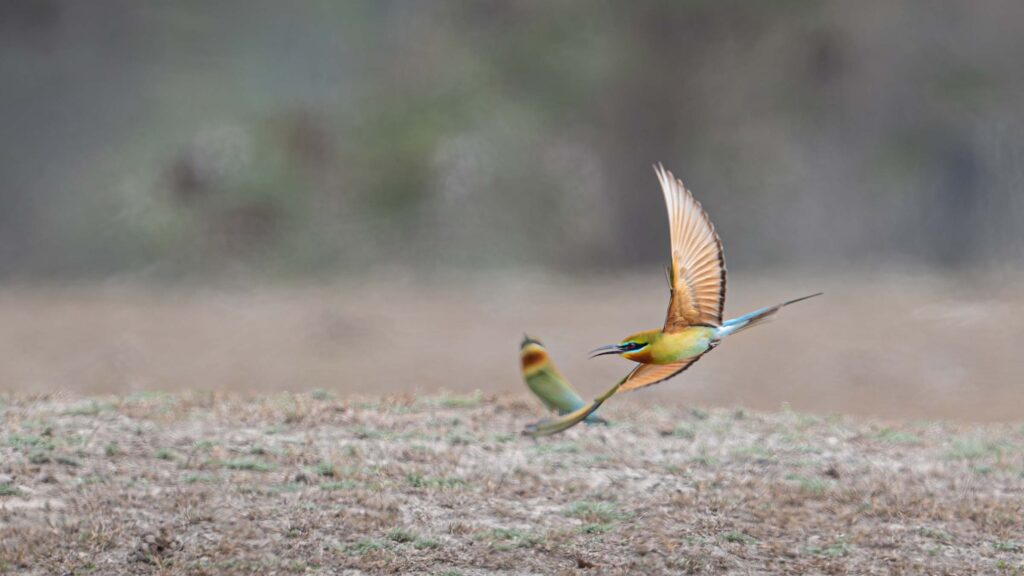
The sand is still there.
The grass still moves in the wind.
The river continues its slow work around the island.
But above it, the Blue-tailed Bee-eaters are moving.
A bird rises.
Another follows.
A pair crosses the sky.
Some return to the nesting ground.
Others disappear towards the feeding landscape.
Below them, the entrances to nesting burrows are scattered across the sandy plain.
There is no signboard announcing the colony.
No monument marks the place.
Only the birds reveal its importance.
For a few months each year, this river island becomes a nursery.
A place of courtship.
A place of digging.
A place of risk.
A place of new life.
And for six years, I have had the opportunity to watch that story unfold.
Perhaps that is the greatest lesson the island offers.
Wildlife does not always need a grand landscape.
Sometimes it needs only a piece of sand, an open sky and enough space to live without being disturbed.
The Blue-tailed Bee-eaters have found that space here.
And as long as the island continues to provide it, the possibility remains that, each February, the sky will fill with wings once again.