
By Shyamal Kashyap
Winter arrives quietly on the Brahmaputra.
The monsoon has withdrawn, leaving behind a river that seems to have no fixed shape. Water divides and reforms around long sandbars, channels of dark current winding between pale islands of sand. Grasses rise from freshly deposited silt. Cattle move slowly across the floodplain. In the distance, smoke from a cooking fire hangs briefly above a settlement before disappearing into the morning air.
These are the chars of Assam — temporary pieces of land created by one of Asia’s great rivers.
They are never truly permanent. The Brahmaputra builds them, reshapes them and eventually takes them away. A sandbank that supports grass and grazing animals one year may be submerged or eroded the next.
Yet during the dry winter months, these shifting landscapes become important places for wildlife.
And high above them, almost lost against the enormous sky, comes a bird from another world.
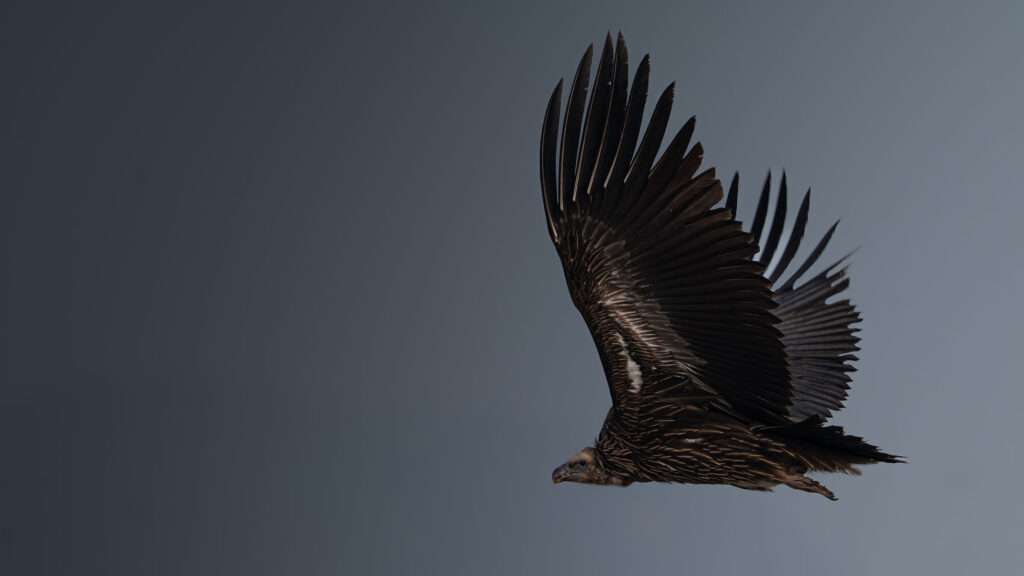
At first it is little more than a dark shape moving without effort, its broad, powerful wings held almost perfectly steady.
A Himalayan Griffon.
Gyps himalayensis is a bird of the high country. Its world is associated with the Himalayas and the great mountain systems beyond them, where cliffs, valleys and vast expanses of open terrain provide the landscapes in which these enormous vultures have evolved.
But in winter, some descend to the plains, often young sub-adults pushed down from high-altitude breeding cliffs by dominant adults.
Here, thousands of meters below the mountains, they encounter a landscape that could hardly be more different from the one above the snowline.
There are no precipitous cliffs.
No frozen slopes.
No thin mountain air.
Instead, there is the Brahmaputra: broad, braided and restless, spreading between sandbars and floodplains beneath a pale winter sky.
The griffons have come down to the lowlands.
And here, on the chars, the great scavengers find the one resource that matters to them above all else: food.
A River That Makes and Remakes the Land
The Brahmaputra is often described as a river, but that word seems inadequate for what happens here.
It is a force that continually rearranges the landscape.
During the monsoon, enormous volumes of water move through the valley, carrying sediment downstream. Banks collapse. Channels widen and narrow. Sand and silt are deposited in new places.
When the floodwaters recede, the river leaves behind a landscape of extraordinary openness.
Some chars are little more than exposed sand.
Others become covered with grasses and vegetation. Some are used by people and livestock. Others remain relatively undisturbed for a season or two before the river changes them again.
This constant disturbance is part of the ecology of the floodplain.
The landscape may look unstable to us, but many species have adapted to precisely this kind of uncertainty.
For scavenging birds, the surrounding floodplain can provide another attraction.
Livestock are an important part of life on many riverine grasslands and chars. Where cattle and other domestic animals are present, carcasses can occasionally become available through natural mortality, illness or other causes.
For a scavenger, such a resource can transform an otherwise empty-looking stretch of floodplain into a feeding ground.
A griffon does not need a forest.
It needs open country, the ability to travel efficiently through the air and, somewhere below, the possibility of finding food.
The Brahmaputra provides the first two in abundance.
The seasonal human landscape can provide the third.
The Mountain Comes Down
There is something almost contradictory about a Himalayan Griffon over the Brahmaputra.
The bird’s name immediately evokes mountains.
Its immense wings seem designed for the great vertical spaces of the Himalayas, where rising air allows a large raptor to travel across valleys and ridges without expending enormous amounts of energy.
Yet the same adaptations work beautifully over the floodplain.
On a clear winter morning, the air above the chars begins to warm. As the sun rises, pockets of warmer air develop above the land.
A griffon can use these rising currents.
Its wings barely move.
It circles upward, gaining height without the frantic wingbeats associated with powered flight.
From the ground, it can look almost stationary.
Then, once sufficient altitude has been gained, the bird tilts its wings and begins to travel.
A few minutes later it may be far from where it first appeared.
This is the economy of a soaring scavenger.
The bird searches from the sky rather than from the ground.
A carcass that would be almost impossible to locate from eye level can become visible from above, particularly in open country.
And a griffon is not necessarily searching alone.
Where food is discovered, other scavengers may gather. The appearance of several large vultures circling in one part of the sky can itself become a signal, drawing attention from birds travelling farther away.
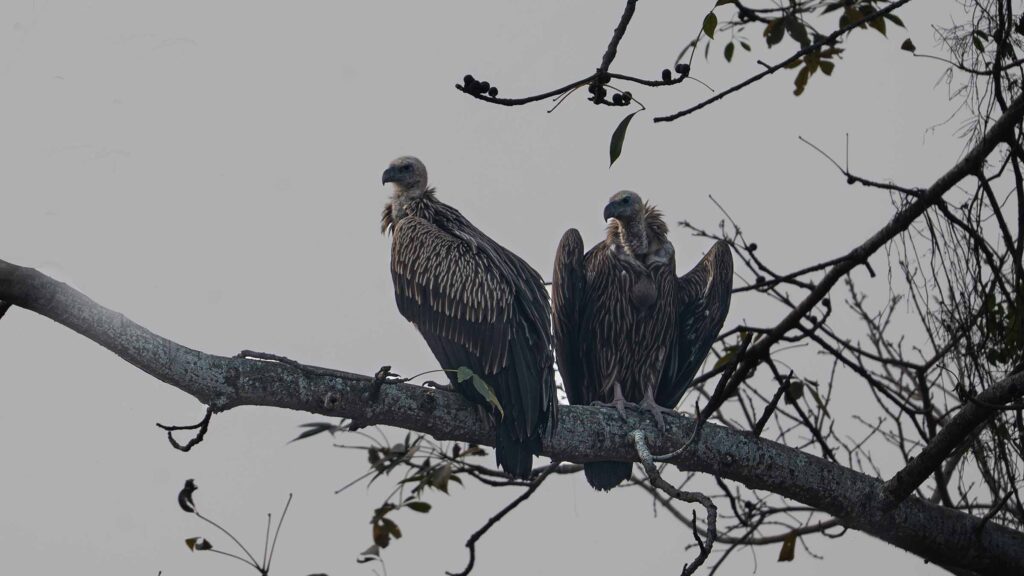
The floodplain can therefore function as a vast visual landscape.
The birds scan it from above.
The river moves below.
And somewhere between the two, the next meal may be waiting.
Life beyond the Park Boundary
It is easy to associate Assam’s wildlife with its famous protected areas.
Kaziranga has become synonymous with the one-horned rhinoceros. Nameri is known for its forests and riverine landscapes. Manas and Orang protect other remarkable assemblages of wildlife.
These protected areas are indispensable.
But the ecological map of Assam is larger than the map of its protected areas.
The Brahmaputra chars demonstrate this particularly well.
Many of these seasonal landscapes are not national parks or wildlife sanctuaries. They are shared spaces, used by people and livestock while also serving as habitat for wild animals.
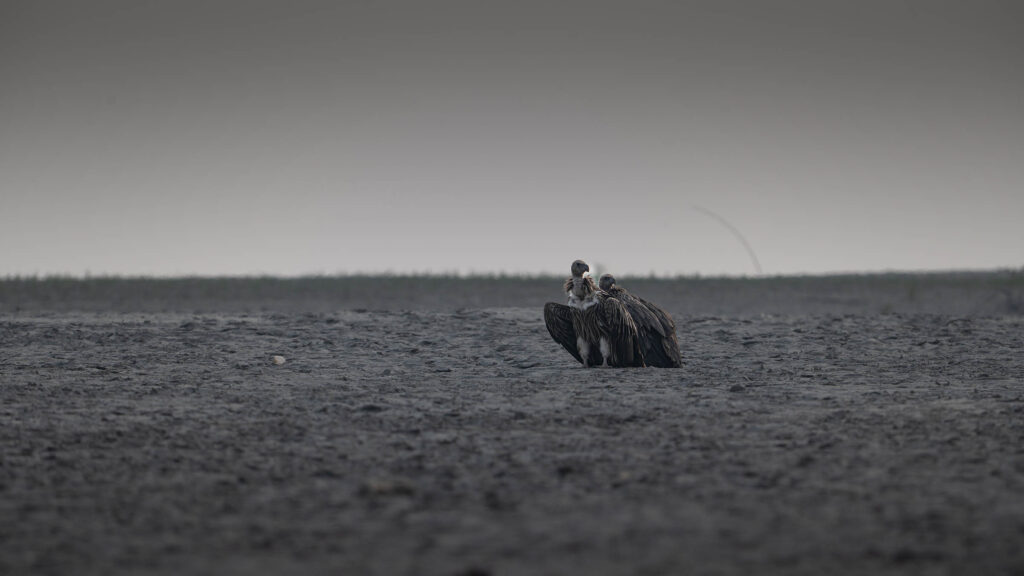
A wintering griffon does not recognise a protected-area boundary.
It follows food.
It follows weather.
It follows the landscape.
One day it may circle above a protected grassland. The next, it may be over a village grazing ground or an exposed riverbank many kilometers away.
For a bird capable of travelling vast distances, the distinction between these places is a human one.
Ecologically, they form part of the same landscape.
This is an important point for the conservation of raptors.
Protecting individual sanctuaries is essential, but migratory and wide-ranging species also depend on the countryside between protected areas.
Their survival can be influenced by what happens on farmland, grazing land, riverbanks and community landscapes.
The spaces outside the parks are not necessarily empty spaces.
They can be part of the wildlife landscape too.
The Risk Hidden in a Carcass
From a distance, a Brahmaputra char can appear almost untouched.
There may be little more than grass, sand and sky.
But a scavenger sees the landscape differently.
For a griffon, the discovery of a carcass can mean the difference between finding food and continuing the search.
That dependence also creates a vulnerability.
A carcass can carry whatever substances entered the animal’s body before it died. In landscapes where agricultural chemicals or other toxic substances are misused, scavenging birds may be exposed to poisons indirectly.
This is secondary poisoning—the toxin was never meant for the scavenger. The bird simply arrives later to a meal that has become a trap.
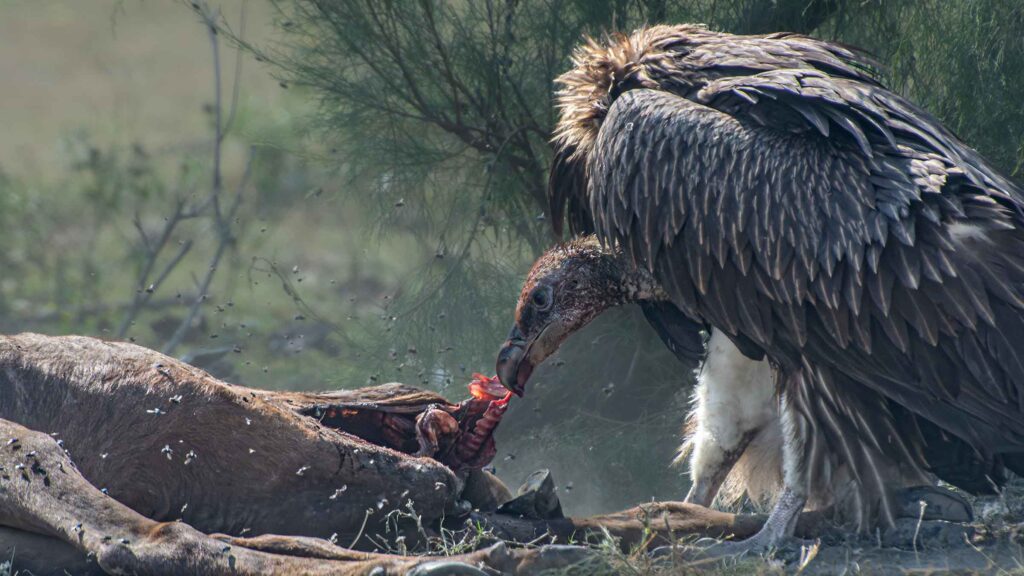
For a scavenger, the boundary between food and danger can therefore be almost invisible.
The carcass looks like food.
The bird has no way of knowing what happened before it arrived.
This is one of the less obvious threats facing vultures and other scavenging raptors. There is no dramatic chase and no warning sound. A bird may simply feed and die.
That makes awareness on the ground particularly important.
The health of a scavenger population can depend on decisions made by people who may never even see the birds that benefit from their landscape.
The People of the Chars
The Brahmaputra’s floodplain is not wilderness in the conventional sense.
People live here.
They have learned to work with a river that can alter the shape of their surroundings within a single season. Livestock move across grasslands and sandbars. Cultivation follows the possibilities offered by the floodplain. Settlements adapt to erosion, flood and shifting land.
The relationship is not always easy.
The river gives fertile soil, pasture and water, but it can also take land away.
Wildlife is another part of this complicated landscape.
Conservation here cannot simply mean drawing a line around an area and declaring it protected.
The chars are too dynamic for that approach.
The animals move through them.
People use them.
The river continually changes them.
For Himalayan Griffons and other scavenging birds, coexistence therefore matters.
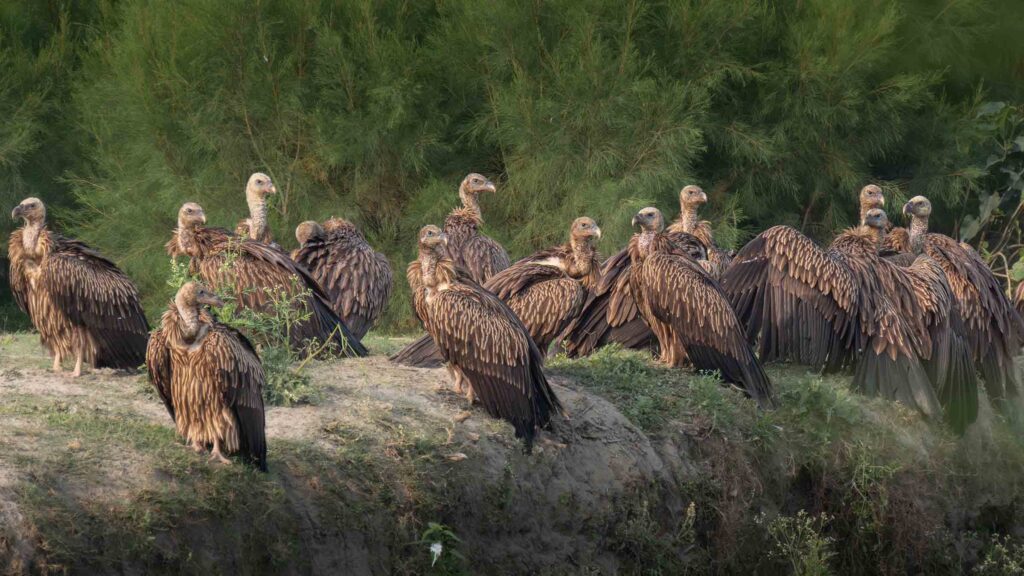
A healthy relationship between livestock owners, farmers and scavengers can benefit both wildlife and the wider ecosystem.
The birds themselves perform an ecological service that is easy to overlook.
They consume carrion.
They remove dead organic material from the landscape.
They return nutrients to the food web.
Scavengers are sometimes viewed only through the uncomfortable image of death.
But death is precisely where their ecological role begins.
The carcass that looks like an ending to us becomes the beginning of another process.
A griffon arriving at a carcass is not an interruption to nature.
It is nature continuing.
A Different Kind of Wildlife Watching
On the Brahmaputra, wildlife watching often means looking across enormous distances.
A small movement on a sandbar may turn out to be a flock of waders.
A shape in the grass may resolve into a grazing animal.
And sometimes the most rewarding sightings are above rather than ahead.
The first sign of a Himalayan Griffon may be its shadow.
Then the bird itself appears.
Its pale body catches the sunlight while the dark flight feathers define the enormous wings. It circles once, perhaps twice, and then begins to drift downwind.
There is no call.
No dramatic wingbeat.
The bird simply moves with the air.
Watching such a bird over the chars changes the way the landscape appears.
The sandbank is no longer merely a barren strip beside the river.
The grass is no longer just grazing land.
The sky itself becomes habitat.
For the griffon, the entire floodplain is part of a search pattern.
Every thermal may carry it farther.
Every gathering of scavengers may offer a clue.
Every patch of open ground may be worth examining.
The bird is reading the landscape from a height that humans can barely imagine.
Two Landscapes, One Journey
The presence of Himalayan Griffons on the Brahmaputra also reveals something larger about the geography of wildlife.
The Himalayas and the Brahmaputra valley are often thought of as separate worlds.
One is defined by mountains.
The other by floodplains.
But animals connect them.
A bird that spends part of its life in the high country can appear months later above a river hundreds or thousands of meters lower.
The journey links ecosystems that, from the ground, seem completely unrelated.
For the griffon, however, they are part of the same seasonal world.
The high mountains provide breeding habitat and the ecological conditions to which the species is adapted.
The plains can provide opportunities during the colder months.
Between these places lies a vast landscape of valleys, forests, grasslands, rivers and human settlements.
The bird carries that connection in its wings.
This is why the appearance of a Himalayan Griffon over a Brahmaputra char is more than an unusual bird sighting.
It is evidence of ecological connectivity.
A reminder that wildlife conservation cannot always be confined to one habitat or one administrative boundary.
When the Sky Changes
Winter does not last forever.
The light changes.
The grasses begin to lose their winter character. Temperatures rise. The Brahmaputra prepares for another cycle of flood.
The griffons that came down to the plains will eventually disappear from the winter sky.
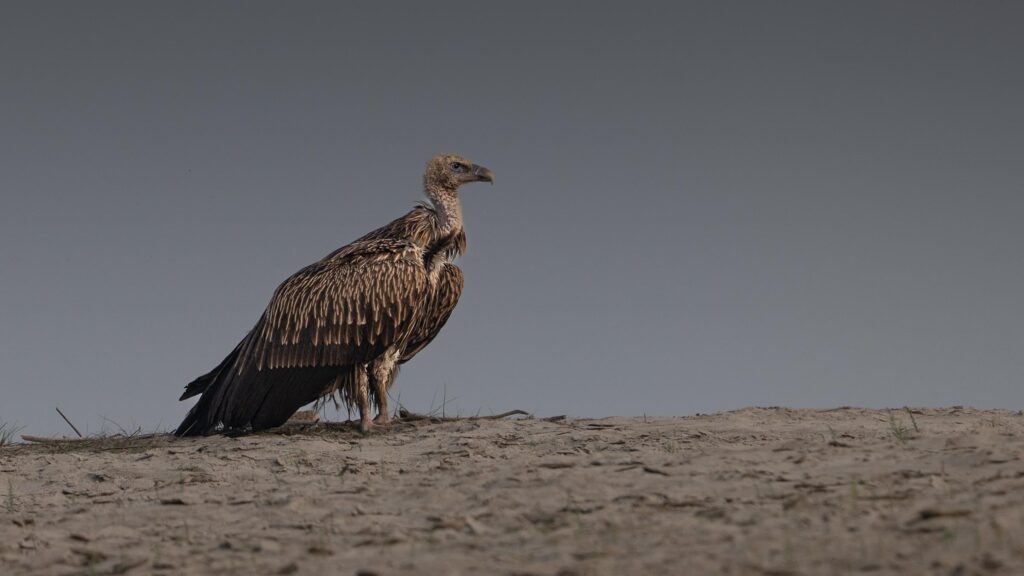
Their absence may be almost as difficult to notice as their arrival.
One day there are large silhouettes circling above the chars.
Then there are none.
The birds have moved on.
Their return journey takes them towards the mountain landscapes where the next stage of their lives will unfold.
Below, the Brahmaputra continues without pause.
The river does not wait for the birds.
It keeps shifting its channels, building new sandbanks and eroding old ones.
The char where a griffon fed one winter may not look the same when the birds return.
Perhaps it will be larger.
Perhaps it will have disappeared.
Perhaps another sandbar will have taken its place.
That is the nature of this river.
Nothing here is entirely fixed.
Shadows on the Sandbanks
Late in the afternoon, the winter sun begins to sink towards the western horizon.
The sand loses its brightness.
The river darkens between the channels.
Cattle become silhouettes against the grass.
And somewhere above the floodplain, a Himalayan Griffon catches the last of the day’s warm air.
For a moment, it hangs almost motionless.
Below are the chars of the Brahmaputra.
Beyond them are villages, grazing grounds and open floodplain.
Far beyond the horizon are the mountains.
The bird seems to belong to all of them.
That is perhaps what makes the sight so compelling.
The Himalayan Griffon is a bird of the high country, yet during the winter it becomes part of the life of the lowlands. Its presence on the Brahmaputra’s sandbanks connects two very different landscapes — the roof of the world and the great river plain below.
But the connection is fragile.
The chars are temporary.
The food resources are seasonal.
The birds are exposed to the risks of a landscape that lies largely beyond protected-area boundaries.
Their future therefore depends on more than what happens in the mountains.
It depends on the wider floodplain.
On the health of livestock and grasslands.
On the way chemicals are used.
On the safety of carcasses.
And, ultimately, on whether people sharing these riverine landscapes recognise the birds moving silently above them as part of the same living system.
The Brahmaputra will continue to change—building and destroying its islands, redrawing its channels year after year.
The griffons will come and go with the seasons.
And for a few winter months, those great wings will cross the sky above the sandbanks.
A shadow passes over the pale ground, and then it is gone. Only the river remains…